
"Born To Run,' then what?
You've got that one great song...

Sitting on the edge of his bed somewhere in the swamps of Jersey, feeling the pressure from his record company to come up with a hit — if he wanted to keep recording, that is — Bruce Springsteen comes up with a riff, then painstakingly, transforms it into a song called “Born To Run.”
The track seems like a bit of a breakthrough for him, concise, powerful, unlike the delightfully sprawling pieces like “Rosalita” and “Kitty’s Back” that seemed so great on his second album, “The Wild, The Innocent, The E Street Shuffle,” but not particularly radio-friendly, except for some FM stations. As good as that album was, Side Two was perfect in my eyes, it didn’t sell enough, Columbia said. If the company was going to spring for more Bruce time in the studio, they needed to hear a single.
That’s the story shared in Peter Ames Carlin’s “Tonight In Jungleland, The Making Of ‘Born To Run.” But Bruce’s issues with the record company aside, there was another more serious problem bubbling beneath the surface, one that pretty much every artist except maybe The Beatles, ran into. Ok, great, fantastic. You’ve got one great song. Now what?
Speaking on the terrific video “Wings For Wheels” that accompanied the box set re-issue of “Born To Run,” Bruce’s former manager Mike Appel explains this point very well.
““Born To Run’ being cut,” Appel says, “this pompous rock anthem, Springsteen had the task of trying to find other songs that were as good as it. And that’s an astronomical task for anybody, even if it’s Bruce Springsteen you’re talking about.”


That’s a situation that, looking back through rock history, other bands and artists have faced. As exciting as it has to be to know you think you have one great, rip-snorting song to kick off this next album, what if the rest of the tracks don’t quite measure up?
Not every band is like The Beatles, who, when starting to record “Sgt. Peppers,” had John Lennon offer “Strawberry Fields Forever, then Paul McCartney tossing out “Penny Lane.” And George Martin didn’t put either one on the final record!
So you wonder (A.) how the rest of the recording world kept on going and recording and (B.) ultimately, what that one song did for their career. The first song The Who recorded out of a collection of songs that were originally intended as a rock opera called “Lifehouse,” might have been their best cut out of all the songs that would eventually become “Who’s Next.”
If the liner notes are correct, the song “Won’t Get Fooled Again,” not only closed that album but was arguably the definitive Who song. Yet it was also the first song recorded. What can you do for an encore, Pete?
Fortunately, Townshend also came up a second anthemic cut, “Baba O’Riley,” that Pete said was written about the devastation he saw at the conclusion of the Woodstock Festival in 1969 “where everybody was smacked out on acid and 20 people or whatever, had brain damage.”
The Who were featured at Woodstock and their dynamic performance was one of the genuine highlights of the film. But to Townshend, what he saw at festival’s end was “a teenage wasteland,” a celebrated line from the song, but oddly, not the title. For the song’s title, Townshend combined his genuine devotion to guru Meher Baba and his affection for the music of Terry Riley into his makeshift, inexplicable title “Baba O’Riley.”
Appearing on the Colbert Show and selecting it as one of his top five all-time songs, Townshend noted that “Baba O’Riley” now had 1.5 billion streams on Spotify. This is despite a title that made absolutely no sense to anyone else.
Reportedly, Nirvana’s “Smells Like Teen Spirit” was the first track recorded for “Nevermind.” Aerosmith started “Toys In The Attic” with “Walk This Way,” and Coldplay’s “Clocks” from “A Rush Of Blood To The Head” was also the first piece recorded for that album. U2’s “With Or Without You,” the initial single from their breakthrough album “The Joshua Tree,” was also the first track cut.
Sure, just about all these artists found ways to do some great work once they had that opening killer cut in the can. As it turned out for Springsteen, the second track after “Born To Run” was the legendary “Jungleland,” which featured saxophonist Clarence Clemons’ moving nearly three-minute sax solo. According to “Wings For Wheels,” it was Springsteen actually conducted Clemons’ solo note-for-note, standing behind producer Jimmy Iovine in the studio for hour after hour until he got Clarence’s solo just so. The results were extraordinary. Maybe that gave Bruce the confidence to keep going. Or maybe the guy was so driven, he would have logged a thousand studio hours anyway.
If you’re a Bob Dylan devotee, you should have heard the story by now about “Blind Willie McTell,” the very first track cut for Dylan’s “Infidels” record. The album was somewhat of a comeback/return to secular music for Dylan after what many people took as a nebulous excursion into strictly Bible-thumping religious music with “Slow Train Coming” and “Saved” and “Shot Of Love.” There were some great songs on all those records, for sure. But hearing Bob preach “You either got faith or you got unbelief and there ain’t no neutral ground,” was sort of a drag for many people. I saw that tour in Worcester. And as much as I’ve loved Dylan’s work (written three editions of a book about the guy), that concert wasn’t much fun.
For “Infidels,” Dylan had initially hired Mark Knopfler of Dire Straits to produce the record, beginning at New York’s Power Station. For various reasons, depending on who you listen to, Knopfler was unable to hang in for the finished product and later said he was disappointed with the final release. He was wondering, like most of the rest of the Western World, why “Blind Willie McTell” didn’t make the final cut.
Though Dylan reportedly said later he didn’t think the track was good enough, maybe he had another reason, one which wasn’t true, necessarily but that’s our Bob. After writing that masterpiece, maybe he didn’t think he had a better song left in his quiver. Which might well have been true. But who did?
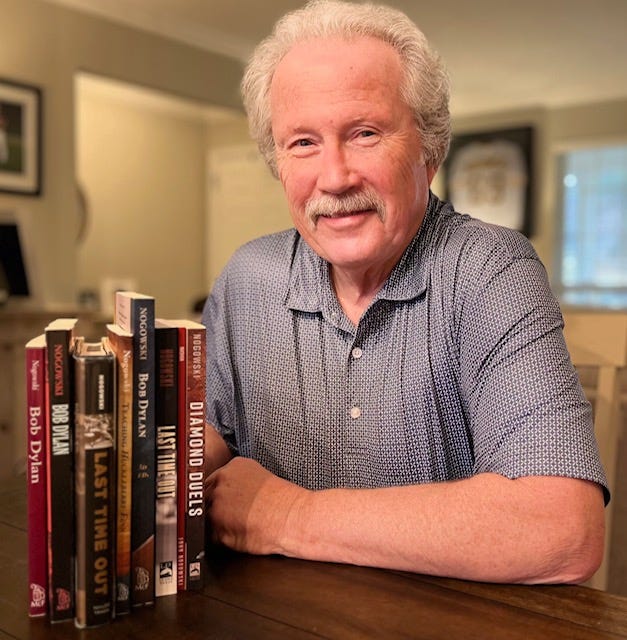
Author John Nogowski, who regularly contributes to the Hartford Courant, has also written three editions of “Bob Dylan: A Descriptive, Critical Discography and Filmography” for McFarland and a forthcoming book on Neil Young - “Neil Young: A Descriptive, Critical Discography and Filmography” due later this year. He’s also written two books on baseball - “Diamond Duels” and “Last Time Out,” a book on his experience teaching Mark Twain’s classic “Teaching Huckleberry Finn” and a book on one memorable week in the 1980 Republican Presidential primary in New Hampshire - “Nashua: How Ronald Reagan led us to Donald Trump.” All are or will be available on Amazon.
Fabulous piece John, thanks. So many great songs got cut from albums that they should have appeared on. I appreciate that The Band recorded a bluesy, swamp rock version of Blind Willie McTell on their Jericho album. Their eighth studio album which was released in November, 1993, seven years after The Band had abandoned studio recording after the suicide of Richard Manuel. All of The Band members are gone now but their music lives on and with that album they gave us covers of Bob and Bruce that are also worthy of a listen.