
Defending Mark Twain?
Do I need to stick up for the ol' guy?

“We got Twain when we got him, and thank goodness we did, and God help the culture that pretends that earlier stupidities never happened and tries to eradicate all evidence of them.” George Saunders, “The United States of Huck.”
It was a full quarter-century ago that the estimable George Saunders wrote “The United States Of Huck” as the Introduction to a new edition of Mark Twain’s “Adventures of Huckleberry Finn.” In full disclosure, Mr. Saunders was kind enough to allow me to reprint his superb Introduction in my own book, “Teaching Huckleberry Finn.” It was something I used in my classroom as part of our discussion of Twain’s book and a way to help my students, almost all African-American, examine the many sides of his controversial novel.
His words - “We got Twain when we got him” - rang in my reddening ears as I sat in Thomasville’s “The Bookshelf” the other day, reading Ruth Franklin’s “Twain Town U.S.A.”, an essay that appeared in the latest issue of “The American Scholar.” A day earlier, I’d read a lengthy - but fascinating -- story in Harper’s Magazine by John Jeremiah Sullivan called “Twain Dreams.” Mr. Clemens died in 1910 but his words haven’t.


Mark Twain certainly doesn’t need some cranky old retired teacher sitting in his den coming to his defense. But I want to do it anyway. Judging a 141-year-old book - and its author - by contemporary standards and values and prejudices seems, to me at least, wrong-headed and unfair. Now, I recognize Ms. Franklin certainly is an accomplished literary critic and “The American Scholar” always seems to have something worth thinking and talking about in every issue.
But her “Twain Town U.S.A.” seemed to take aim at Twain and the undeniable cultural impact of both the “Adventures Of Huckleberry Finn” and “The Adventures of Tom Sawyer,” as if some of the built-in wrongs of American society could be pinned to these novels. That’s how I read it, anyway.
Her story takes place in Hannibal, Missouri on the Fourth of July on National Tom Sawyer Day, now in its 70th year, where the town has what seems to be a fierce competition to name a “Tom Sawyer” and “Becky Thatcher,” after characters in Twain’s novel. And Twain, as Franklin notes, is big business in Hannibal.
There’s the Mark Twain Boyhood Home, The Mark Twain Cave, “the Mark Twain Casino, Becky’s Old Fashioned Ice Cream Parlor & Emporium, Clemens General Store, and more. Even a bottled-water vending machine bears a quote from Twain: “High and fine literature is wine, and mine is only water; but everybody likes water.””
Of course, this is way over the top but can we blame Twain for that? And how are we supposed to remember literature from that time? For what it brought us or what it didn’t?
Franklin notes Twain’s complex history. “A child of slave owners, he married into an abolitionist family and ultimately wrote “Adventures of Huckleberry Finn,” which is generally acknowledged as one of the greatest works of American literature, with a deeply antiracist message.
“At the same time, the book has been criticized and even banned for its frequent use of the n-word and perceived racial stereotyping. The runaway success of Percival Everett’s 2024 novel “James,” a retelling of the Huck Finn story from the perspective of Jim, the enslaved man who is Huck’s companion, shows that interest in Twain remains high even as contemporary readers increasingly acknowledge the ways in which his books inadequately represent the experience of Black people.”
I had to read that again. “his books inadequately represent the experience of Black people.” It was written 141 years ago. To have the most popular writer in America, just twenty years after the Civil War, take on racism - and let’s face it, that is the central topic of the book - didn’t that take considerable artistic courage? This was just 20 years after the Civil War, with veterans on both sides still alive and, we presume, reading.
Should we have expected Twain to be able to “adequately present the experience of Black people?” In 1885? Were there a lot of American authors at that time willing to take on the issue of race? I must have missed that chapter in American Lit.
Franklin’s assessment of Everett’s “James,” a re-telling of Huck Finn, this time from the perspective of Jim, the runaway slave, “shows that interest in Twain remains high.” That’s one way to look at it.
Another might be to suggest it’s literary revenge, of a sort. “I’m going to bring back Jim and, uh, I’ll make him an intellectual.” In other words, Twain was really selling Jim short, so Everett took the ball and really ran with it. As Sullivan notes in Harper’s “Twain Dreams,” that’s a bit much.
“The place where Everett has left himself open to the most obvious criticism is in his decision to make James an intellectual. The man is not merely intelligent, in other words, in the way that any healthy, alert person might be. He is instead a highly literate and systematic thinker, who, when he dreams, is visited by John Locke and Voltaire. They discuss such topics as the nature of civic equality and natural rights and the real-world responsibilities of philosophers. It’s absurd….”
Whatever your thoughts on Twain, his use of the “N-word” (for authenticity, in my view - that’s how people spoke then) he clearly and I think bravely depicted Jim as uneducated but nurturing, caring and loyal. Was it a perfect portrait? No. But does the reader, particularly then, come away from the book, thinking Jim is the hero, the best person in the novel? Let me say that again. Particularly then.
Maybe I’m naive, but I think that was Twain’s intent. In 1885! And in spending a dozen years in a classroom teaching the novel to an audience of young African-Americans, it worked for many of them. One student wrote me: “Mr. Nogo: Huck is the brother I never had.” Another student skipped his lunch, walked all the way across the campus to ask me one question. “I’ve gotta know, Mr. Nogo. Will Jim get to Cairo today?”
There are other issues with “Twain Town, U.S.A.” that seem wrong-headed. When Franklin describes the engagement scene between Tom and Becky, “During our conversations, I asked some of the Beckys whether they were troubled by the gender dynamics, but no one took the bait.” The “gender dynamics”? What would Twain have done with that phrase?
Franklin also discovers a one-room museum opened by G. Faye Dant called “Jim’s Journey: The Huck Finn Freedom Center” that explains Hannibal’s Black history, which, her “Twain Town, U.S.A.” makes clear isn’t something citizens spend much time with.
“People that like American literature … are some of our brightest people,” G. Faye Dant tells me. “But they go right over there to Huck Finn’s house and don’t walk across the street to Jim’s place. A lot of people don’t want to make that connection.”
Is that all that surprising? You’re in Hannibal and if you’re there, chances are you came to find out about Mark Twain, not America’s unforgivable sin, slavery. There is no getting around it, slavery happened. And I don’t know that we’ll ever get over it.
When I drove to the South from Michigan thirty-four years ago, I remember going around a corner in Georgia and coming upon an empty cotton field. And I choked up. “My God. Slavery happened here.” I had to pull over.
As Sullivan notes in closing “Twain Dreams” he quotes the American historian Arthur G. Petit: “Twain befriended Frederick Douglass, financed a black artist’s apprenticeship in Paris, and supported several black students through Yale Law School. As Mark Twain he lectured in all-black churches, championed the cause of Booker T. Washington, wrote blistering essays about atrocities committed against blacks, and gave large doses of dignity and power to three of the outstanding black characters in nineteenth-century literature. He began his career as a segregationist, turned himself into a champion of interracial brotherhood, and ended his life as a prophet of racial war.
“ “Having learned about the man’s protean personality,” Pettit writes, “we find that his feelings on race and region move in an intelligible direction . . . there is a clearly traceable movement away from the white South and toward the black race.”
In “Twain Town, U.S.A.” Ruth Franklin doesn’t seem to see that side of Mark Twain. Or that Hannibal is doing anything but perpetuating the Twain myth, which, to her, seems so wrong, so one-sided.
It’s as if, in 1885, Mark Twain had only been able to see into our future and tell the real story instead of fanciful tales like “Adventures of Huckleberry Finn” and “Adventures Of Tom Sawyer.”
As Saunders said in “The United States Of Huck,” “we got Twain when we got him and thank goodness we did…”
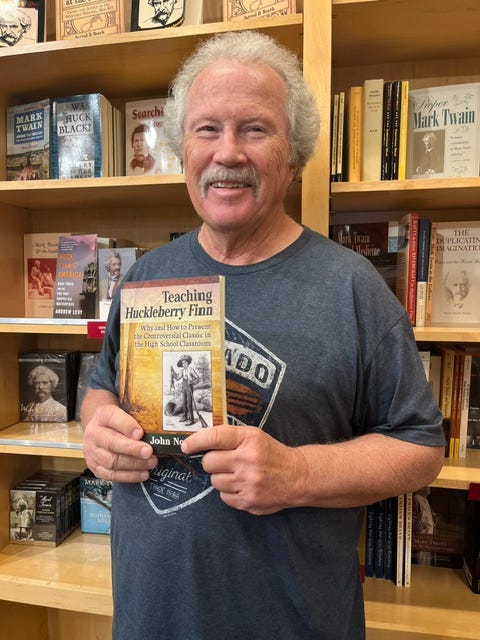
The author of “Teaching Huckleberry Finn” standing in the Mark Twain House in Hartford.
I love Huck Finn! "The Adventures of Huckleberry Finn" and "Things Fall Apart" where the only two boos that I read on my own multiple times... after the assignment was done.
I read Huck Finn in 11th grade in Mrs. Cooney's class at Cass Tech. This was around the time of the yellow cliff notes books (The ChatGPT for millennials). And I am a um... believer of shortcuts and efficiency 😅
But no, while other kids were passing cliff notes of Huck Finn, I told friends:
"Look, our English teachers haven't assigned us a interesting book since 6th grade: Moby Dick. That's half a decade ago... If we cheat on 'Huck Finn', a riveting adventure, they will just give us more boring books like 'To Kill a Mockingbird'. So out of respect for Mrs. Cooney, or Mrs Looney as we call her, and I'm going to read the book she so kindly assigned us. But if you want to cheapen your education and cheat by reading the cliff notes of 'Huck Finn', you go right ahead without me ☺️"
So I read the book and my friends... didn't take my advice, they used cliff notes on Huck Finn... 😅
Now I just want to say I'm not here to defend "N*gger Jim". That character is just... terribly written. So I understand if people are turned off by the book because of that. I get it.
But it's not called, "The Adventures of N*gger Jim"... I'm there for Huck Finn 😅
What I like about the book is the character "Huckleberry Finn". Huck is very naive, and the world thinks he's stupid. But the reader gets to spend time with Huck, and see how clever he is, even if the world doesn't see any of that. As an orphan myself, it helped me understand the world sees me. Obviously I wasn't thinking about any of that, at 15 years old, I just thought Huck Finn was cool kid, and I had no idea where the book was going, I couldn't guess what was on the next page, it was exciting like a rollercoaster 😅
I think "The Adventures of Huckleberry Finn" is a classic that children should read, especially children, specifically orphans. Shakespeare is said to be the Father of Modern English. Pushkin is said to be the Father of Modern Russian. We got Mark Twain, the Father of umm... a dialect of English, commonly known as American English.
So sure, Mark Twain clearly didn't talk to his black friends, like Frederick Douglas, about "N*gger Jim". But how many times have we decided not go to our friends when we should have, for advice, cause "we got this"? I've done that many times, so many times... it's the one thing that I can't remember 😅
Mark Twain wrote a good book with some flaws. I'm not defending the book "The Adventures of Huckleberry Finn" or saying the book isn't racist, that's not what I'm sayin'!!! Please don't take my words out of context...
I'm just saying, I like the book "The Adventures of Huckleberry Finn, that's all I'm sayin' 😅
This is the Son of the Devil; your favorite devil. Til next time, keep it classy 😎
Wonderful my friend !!! All too often people do not take a previous period for what it was a previous period. That is what we today don't have the day to day interactions with customs common at that time so it's important to consider where they were going and what drove them there, before we criticize them.