
Dylan: Still worth talking about...
Why NOT playing "Mr. Tambourine Man" was a good thing

Funny how sometimes when you’re all ready to mount your high literary horse you find out that your pony has been scratched, you’re in a new race and headed in a different direction like you were in Ireland.
Wandering through Trev Gibbs’ “The Joker And The Thief,” web site (Title a cop from Bob Dylan’s “All Along The Watchtower”) I saw a couple of lines that gave me a little hitch. The main topic seemed to be “Bob Dylan Unplugged,” a album that shouldn’t get anybody all that enthused but there were a couple of comments — I thought they were from Trev, actually were I think, from the late, great Peter Stone Brown — that made me want to say “Hold my beer.” (And I really don’t drink!)


The first comment was this — “The last time he really did Tombstone Blues right was in ’65 with the Hawks. I like it when I see him do it, but in retrospect he hasn’t touched the original in any of the live shows in the past 20 years.”
Now Peter Stone Brown has seen Bob Dylan in concert many more times than just about all of us but he sure hasn’t seen EVERY time Bob has sang that song in live shows. So he doesn’t know. Hell, Bob probably doesn’t know and I’ll get to that in a minute.
While I think Peter might well be correct, there’s a damn good reason for that and we all ought to be thankful. You see, Bob wrote that song when he was just a kid and he’s 84 now so if he WAS singing that song as good or better NOW, there’s something seriously wrong with that picture.
For example, our friend Neil Percival Young (who I’m writing about and will have a book out next year) will almost surely trot out “Heart Of Gold” just about every time he trods the boards and it’ll sound just about identical to the first time he played it and that’s ON PURPOSE. I think Neil does it because the fans love it and I think that’s his way of saying “Thanks, kids” and it’s just one song, after all.
It was his biggest hit that landed him in the ditch and all but it also paid him a fortune and gave him the freedom to do whatever the hell he wanted for the rest of his life — which he went and did! So as I see it and hear it, that’s why he plays it.
For Bob, his way of saying thanks is showing up and he doesn’t do requests and if we haven’t figured that out by now - he’s 84! —when, then?
Actually, I did see Bob do a request. He was playing with Tom Petty and The Heartbreakers in Hartford and evidently, he had more than a promise for the after show because the band sort of off-the-cuff tried “Lay Lady Lay” and the only thing worse than Bob’s warbly singing was the Heartbreakers’ “Where are we again?” arrangement. It was so embarrassing, Dylan even apologized in mid-song, explaining that it was a request and “we don’t usually do that one.”
The other time I heard Bob directly deal with a request was again in Hartford, as I recall, a different show. It was in the acoustic part of the set and as soon as one song ended, a beautiful blond lady stood up in the front row and begged.
“Hey, Bob, play ‘Mr. Tambourine Man” pleaaaaaassssseee?” Bob heard her all right and looked right down at her from the stage.
“Nawwww, I ain’t gonna play ‘Mr Tambourine Man,” he snarled. “So sorry.” Instead, he looked right at her and sang as if he meant it —“Go away from my window…” She begs for “Mr. Tambourine Man” and Bob gives her “It Ain’t Me, Babe.” It AIN’T HIM, BABE indeed.
The reason I think we should be thankful — and yeah, it’s annoying that he does this — but I think he had some lucky, self-preserving instinct to not be locked into doing the song the same way ad infinitum.
I might be wrong, it might be his sometimes inexplicable perversity “Naw, I’m keeping that for me” too. How else to explain recording “Blind Willie McTell” as the first song for the “Infidels” sessions, then CANNING IT? And you can say that for lots of songs over the years that we finally got to hear on “Biograph” or “Tell Tale Signs” or somewhere else.
In concert, it seems to me that for him, keeping the arrangements flexible (to say the least) keeps those songs alive and he can’t help himself. HE DOESN’T WANT TO REPEAT HIMSELF.
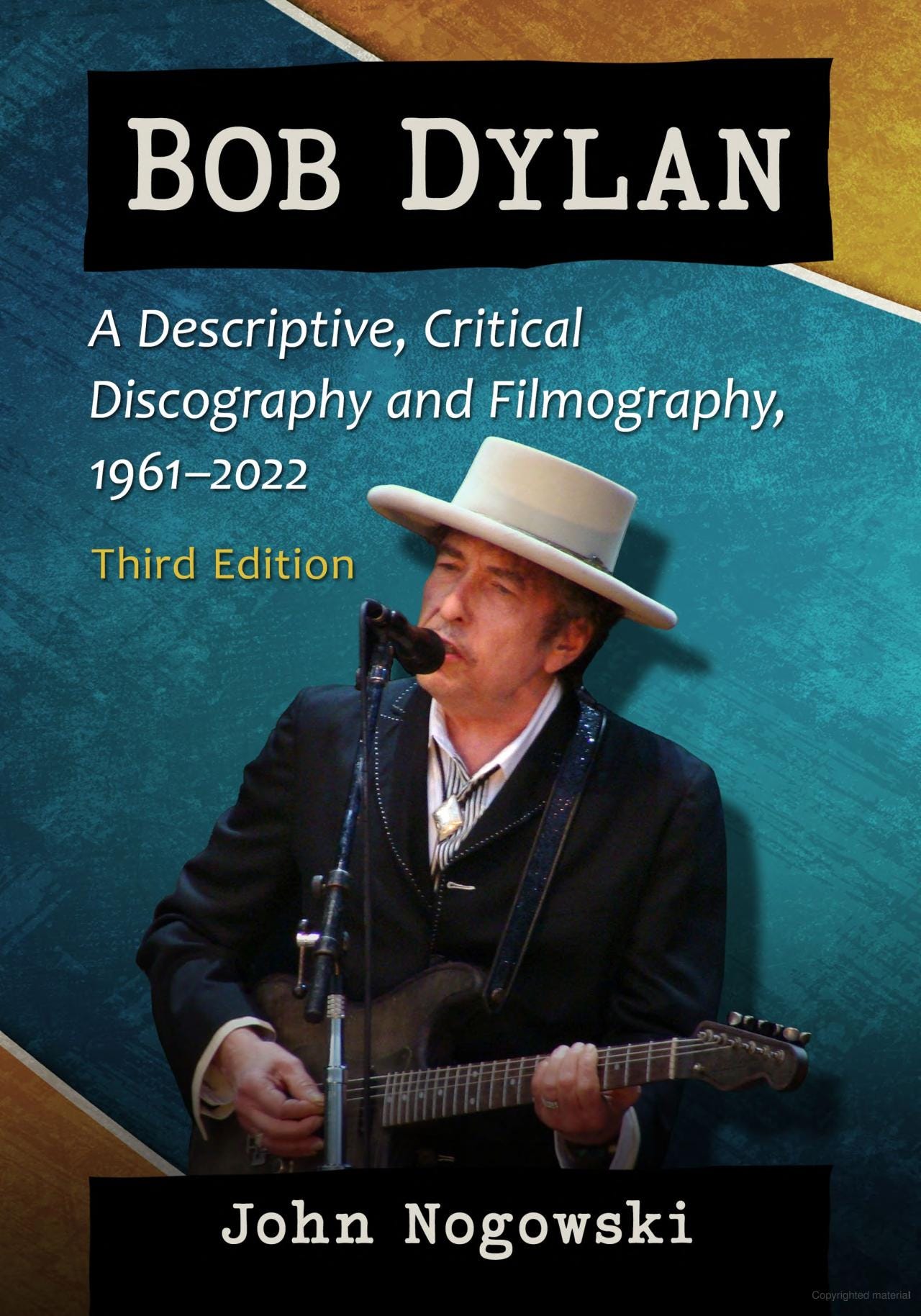
When I saw him in Jacksonville last year, and I would think it’s clear after my writing three editions of Bob Dylan: A Descriptive, Critical Discography (332 pages, available on Amazon) not to mention at least a dozen seriously in-depth Dylan digs on my Substack (Renaldo & Clara, Eat The Document, Masked And Anonymous and others) that I’m at least fairly familiar with his stuff.
Yet there weren’t four songs that I could identify from the opening notes. I had to wait until I heard the song’s title or the chorus to determine what song he was playing so I could explain it to my sweet wife. So if that happens to ME, what about the rest of his audience — you know, the NORMAL ones — who listen to Bob only casually? Of course, they’d be ticked. But I think that’s the deal. If we want to see him keep touring and playing — and we do — we have to go along with him doing these almost all very old songs — even the ones from Rough and Rowdy aren’t that brand-spanking new, it’s been a while since that record came out. I think he’s very much a man of the moment.
And the fact that him doing that with these beloved songs pisses people off, I think he likes that, too. There’s a passage from Larry Charles’ book “Comedy Samurai” where Charles is explaining something to Dylan when they’re making “Masked And Anonymous” and Charles tries to talk Bob out of something, saying that it would be misunderstood. Whereupon Bob came up with — off the cuff — a classic Dylanism: “What’s so bad about being misunderstood.”
This is a major point of departure between Bob and say, the current center of this belated Springsteen revival with the release of “Electric Nebraska” (Suddenly found so as to coincide with the release of the Springsteen movie “Deliver Me From Nowhere,” about the now universally celebrated New Jersey resident, Bruce Springsteen.
At the time of the film, based on Dan Zanes’ book we are told, Springsteen is recording material for what would eventually be the blockbuster “Born In The USA” and there was something missing, he thought, from the full band’s interpretation of these songs, the title song in particular.
Leading off “Born In The USA,” it’s such a dynamic, irresistible track, it seems the relentless power of the music just overwhelms the carefully complex lyric, which is not exactly a celebration of America and how we treated Vietnam veterans. That the chorus DOES celebrate America — there’s pride in the line “I was born in the USA” — just seemed to confuse everybody, including George Will and the easily confused Ronald Wilson Reagan, who brought the song up in a campaign speech, prompting a lively response from Bruce on stage the next night in Pittsburgh.
Just a few days after Reagan’s speech, Springsteen sarcastically wondered what Reagan’s favorite album might have been.
“The President was mentioning my name the other day,” said Springsteen, as he moved into his song, “and I kinda got to wondering what his favorite album musta been. I don’t think it was the Nebraska album [about hard times in America]. I don’t think he’s been listening to this one” [“Johnny 99”].
It MATTERED to Bruce that the song “Born In The USA” was so misunderstood, he took to playing it slower with slide guitar, a medieval blues so that THE REGULAR FOLKS MIGHT GET IT. He even did it on tour and that way on PBS.
Imagine Dylan taking “Like A Rolling Stone” just a few months after it was released and re-doing it as a reggae song so people could really relate. Or something that would either simplify or classify it, I can’t decide which. And I don’t know that Bob could have done it anyway.
Dylan was quick to understand — especially in those halcyon days. If you’ve seen the Time reporter trying to interview Bob in “Don’t Look Back” — Dylan quickly understood that people WEREN’T going to understand what he was doing and that was that.
For Bruce, it bothered him enough to change the way he did the song on stage. He even did a wonderful “Born In The USA” remix — worth hearing — that further illustrates the brilliant and maybe unintentional contradiction within the song itself. That people didn’t get it bothered him.
I used the remix in my AP Literature class and wrote this to help my students get it.
BORN IN THE USA – Bruce Springsteen
You can see the soldiers marching off to war. The drums, mixed high and loud, are like rifle shots. The martial, repetitive, stirring tune, propelled across the piano keyboard again and again and again…the riff that gets between your ears and won’t let go. Yet amidst this grand and powerful song, emerges a lyric that features, perhaps hangs on, a scream. It is a song that to me, explains the allure of war, of soldiers united in a single cause, going off to triumph and at the same time, the lyric expresses the horrors, the disillusionment, the sense of betrayal soldiers feel when they return home. We do not know, feel what they have felt on the battlefield so when they come back to our quiet lives and try and fit in, they are the bump under the blanket, the rock in the road, their emotions and hearts and brains have been so transformed by that horrific experience, they are no longer one of us. But long to be. And that relentless, marching chorus and irresistible tune keeps surging, surging, luring us in. Where are we fighting today? Ukraine? Iran? Afghanistan. Yesterday? Germany, France, Vietnam, Korea. Where will it be tomorrow?
To me, that’s the essence of that song, one of Bruce’s most complex, even though it might not seem it on the surface.
I can’t imagine Dylan responding to the President back then (It would have been LBJ) or if he had, it would have been with some classic Dylan sarcasm like when somebody asked him about paying taxes or something related to the government and Dylan responded with “It’s my UNCLE, man” or something like that.
The other thing that gets thrown out there quite a bit among Dylanologists is Dylan’s performance at The Supper Club where he did what songs he wanted, in what order he wanted and varied the song selection throughout his chronological release history, which seemed intentional. And shame on you, you missed it.
Maybe it’s me, but in writing so gushingly about the Supper Club material (the REAL Dylan unplugged, it was implied) to me, Peter Stone Brown suffered a little bit from what I call “the Paul Williams Syndrome” which refers to the late Paul Williams, who, judging from reading his writing, had to be the absolutely kindest person to exist since Jesus. But he was also was so enthusiastically pro-Dylan — “YOU’VE GOT TO HEAR THIS TAPE” that a discerning listener had to wonder if, given Bob’s unpredictable nature — predictable only in the sense he was going to do what he felt like — that there was ANY performance that could do what Dylan “hadn’t done since 1965”or whatever year you want to pick.
There’s also a little of what I call the Greil Marcus-syndrome in this kind of writing that reflects “I’m getting to hear stuff you never will, so LISTEN to me.” I always hated that, reading stuff in Rolling Stone that made it sound like they were in the know, in tight with the band and maybe even Bob himself and YOU’D NEVER GET THERE SO DON’T TRY. Sort of holding it over our heads. If you disagree with him, well, I guess you’re just NOT ENOUGH IN THE KNOW.
I don’t think Dylan is like that. He’s democratic. What he puts on record, I think, HE THINKS, is for all-time. And that’s where you’re going to get his best and most honest effort. Probably.
As we gave seen, he’s erratic on stage and that includes The Supper Club, still not officially released. I’m not even sure at this point it’s by choice. He just HAS to do it. One of big surprises to me when I first looked at Martin Scorsese’s “Rolling Thunder Revue” (And I saw the tour at Southeastern Massachusetts University) was Bob singing “Tambourine Man” LIKE THE RECORD. That’s just not how he rolls, folks.
And at this point, it seems like enough people understand what they’re getting in concerts is just a sidelight, an apertif to what Bob will deliver on record. I don’t think he can help it. As we heard in Farm Aid 40, where he was hiding behind the keyboards and just picked a few random cuts from his current set list — no statement intended — while Neil Young, who followed him, delivered a mighty politically-oriented set that made it clear where he stood with the horrors of the Trump Administration. Even though he promised on his website he wouldn’t do that. Oh well, Trump has broken a few promises, too, hasn’t he?
So, isn’t it funny how a conversation with someone who isn’t even around led to all this in-depth Bob Dylan discussion. The guy does make you think, doesn’t he? I don’t think he can help that, either.
John Nogowski is the author of “Bob Dylan: A Descriptive, Critical Discography 1961-2022” available on Amazon in its third edition. (332 pages). His book on Neil Young’s extensive music catalog will be released next year (Or when I finish it - 108, 522 words at the moment.)
Bob is always worth talking about. Saw Bob first time back in summer of 1989. At that show the arrangement of Shelter From The Storm was up tempo rocking but nothing like the album. Fast forward to Passover 2005. Five nights of Bob at the Beacon to close spring tour. Now the arrangement is slow tempo, soft and tender.
Caught 4 of 5 nights at the Beacon. Some repeats but such varied set lists.
Gonna leave another piece on my substack about my childhood memory of Dylan. Be sure and enjoy.