
Elvis' pay stub: $37.91
Before The King's coronation

One month and a day before the evening the 19-year-old Elvis Presley walked into Sun Studios at 706 Union Avenue for his first official recording session with Sam Phillips, his pay stub from Crown Electric in Memphis showed Elvis had cleared all of $37.91. It almost makes you laugh, doesn’t it?
Within a matter of a few months, Presley wouldn’t even consider $37.91 tip money. How many people do you know whose life has had that kind of turnabout? It was a rise as improbable as it was remarkable. And to think it almost never happened.
It was at the end of what looked to be a failed recording session that steamy July night, Presley started banging out an old Arthur Crudup tune, “That’s All Right, Mama,” an old blues song Sun Records owner and producer Sam Phillips was stunned Presley even knew.
Phillips came out of the recording control booth, got Presley to back up and start over. He asked guitarist Scotty Moore and bass player Bill Black to follow him and the three of them recorded the Crudup song.
A couple nights later, when Phillips brought the acetate over to his friend and radio DJ Dewey Phillips over at WHBQ a mile and a half away in the lobby of the Hotel Chisca and asked him to give it a spin, neither he, nor Dewey or Elvis had any idea what was going to happen. Nobody could have.


As writer Peter Guralnick explained in the first half of his superb two-volume Presley biography “Last Train To Memphis,” the song was an immediate hot connection.
“The response was instantaneous,” Guralnick wrote. “Forty-seven phone calls, it was said, came in right away, along with fourteen telegrams? – he played the record seven times in a row, eleven times, seven times over the course of the program. In retrospect, it doesn’t really matter; it seemed all of Memphis was listening as Dewey kept up his non-stop patter…”
As we celebrate 250 years of America, the story of the wholly improbable rise of Elvis Presley still surprises us and it always should. Even now, 72 years later, the depth of such an immediate response to a record is startling. It was as if, starting in Memphis, entire cities all across America had kept their late-night radios on for years and years, hoping for some sort of sign or message of hope, excitement, jubilation, anything to shake things up. Here it came from a guy earning less than $40 a week. There was so much more to come. More than anyone could have expected, including Elvis himself.
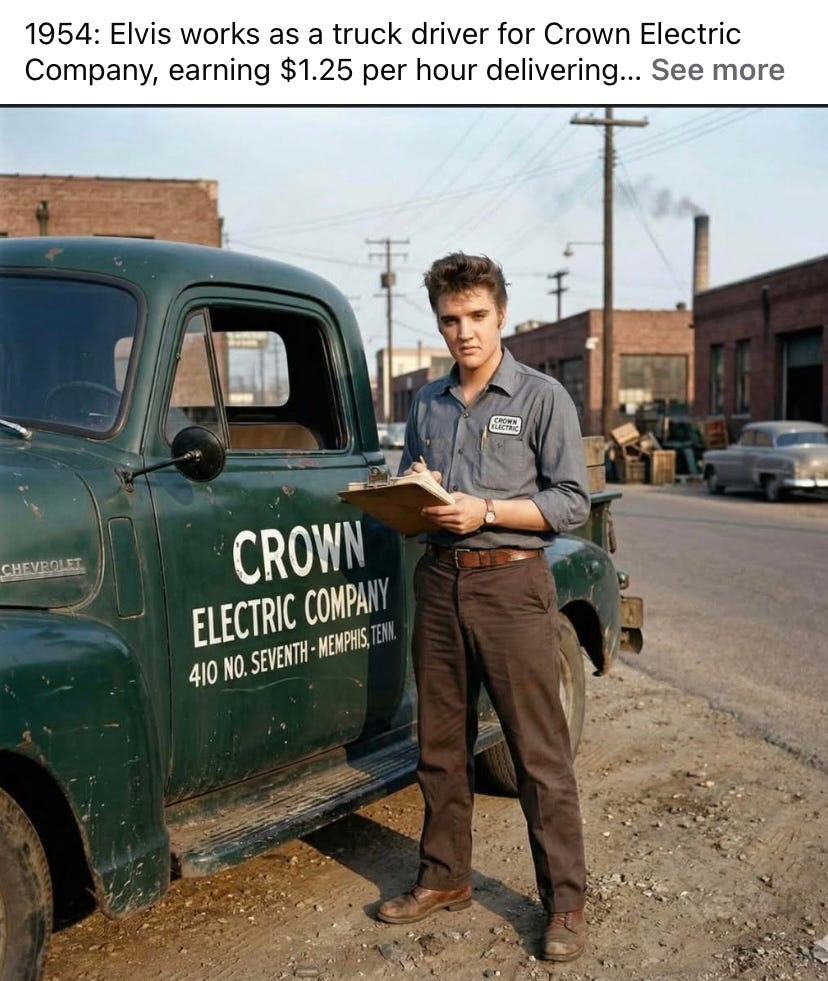
The 19-year-old Elvis Presley, about to become a worldwide sensation.
The artifacts of Presley’s tumultuous life are still being uncovered. What seemed a rather tacky coffee-table book called “Elvis Presley Treasures” came out a couple years ago, collecting 100 items from his life. Here’s a library card Elvis signed taking out Joel Chandler Harris’s “Uncle Remus.” Here’s a job application where Presley is described as a “rather flashily dressed ‘playboy’ type.”
Or how about this, an Elvis-written response to a fan letter, errors and all?
“ Dear xxxx: I have received your letter and I don’t think your crazy. I understand how you feel because before I started singing and lived in the poorest part of town and my father made only 45$ a week. Please try to understand that I cannot do what you ask. It would not be the right thing to do. Also somday you will be glad I didn’t! There is somebody in this world that’s meant for you and you only. With him only you will find happiness. I don’t love you and I doubt if I ever could so let’s please be friends and let it drop there. You don’t know the kind of life I lead and the letters I receive so please understand. Your friend, Elvis Presley. P.S.: If you write again, send me a picture for my scrapbook.”
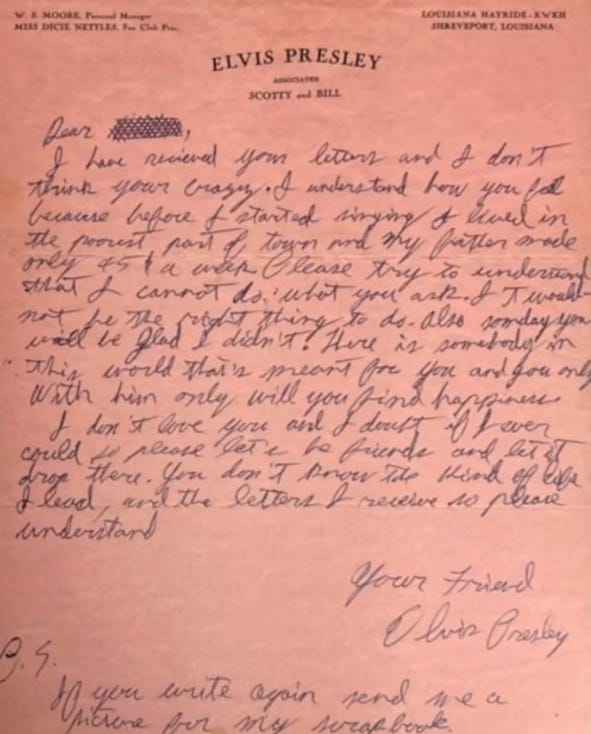
Can you imagine getting a letter back from Elvis Presley, especially one as considerate and gentle as this?
“You don’t know the kind of life I lead,” he says and at this stage of stardom, we can only imagine what he might be talking about. And Elvis keeping a scrapbook, as if he couldn’t quite believe all that was happening to him and wanted to paste some of those letters and newspaper stories so he could believe it, too.
In an earlier Guralnick book “Lost Highway,” there’s a line from Elvis that appeared in the Saturday Evening Post around this time that shows he was as mystified as everyone else.
“I don’t know what it is,” Elvis told writer C. Robert Jennings. “I just fell into it, really. My daddy and I were laughing about it the other day. He looked at me and said, ‘What happened, El? The last thing I can remember is I was working at a can factory, and you were driving a truck.’ We all feel the same way about it still. It just…caught us up.”
In some ways, in 2026, the life of Elvis Presley, at least the first half of it, seems almost impossible to believe. Could something like that still happen in America?
Reading Guralnick’s two-part biography of Presley, Bob Dylan offered this:
“Unrivaled account of Elvis as he walks the path between heaven and nature in an America that was wide open, when anything was possible, not the whitewashed golden calf but the incendiary atomic musical firebrand loner who conquered the western world, he steps from the pages, you can feel him breathe…”
We can still hear him sing, too. Can talent and drive still triumph? It did once. Was that enough? Can we ever truly measure the distance Elvis Presley traveled, from where he was to where he rose?
Starting at $37.91 a week.

Author John Nogowski writes often about popular music on his free Substack, now in Year Three. He’s written three editions of a comprehensive book on Bob Dylan: “Bob Dylan: A Descriptive, Critical Discography and Filmography,” a forthcoming book on Neil Young: “Neil Young: A Descriptive, Critical Discography and Filmography,”; two books on baseball - his son is a former major-leaguer - “Diamond Duels,” a deep dive into the game’s great historic matchups, “Last Time Out,” a collection of stories about the final games of baseball’s greatest players and a book about his experiences teaching Mark Twain’s “Adventures Of Huckleberry Finn” at a struggling minority Florida high school for a dozen years. He’s a regular contributor to the Hartford Courant and is currently at work on a book on Bruce Springsteen.