
Elvis: Where it all started
Dewey Phillips and "Red, Hot and Blue" on WHBQ

Last week, I wrote about the unusual experience of watching “EPIC - Elvis Presley in Concert” in an otherwise empty Tallahassee theater. It was me and The King and it was cool. Unprecedented. Worth remembering. And I loved the movie.
Since then, after reading the rapturous, nearly Biblical accounts of Elvis fans on Facebook and elsewhere, evidently for many folks, the opportunity to watch the film was just extraordinary.
“I’ve seen it 16 times and I’m going again tonight,” one said. “I will go every night this is at the theater,” added another and so on. Clearly, Baz Luhrmann’s film struck the kind of nerve I wasn’t sure America still had.
Frankly, it got me to thinking about the very first guy to bring us Elvis Presley. A guy who, had he not opted to play this acetate that was recorded by somebody nobody ever heard of at a tiny studio just a mile and a half from the lobby of the Hotel Chisca at 272 South Main Street where WHBQ 560 broadcast six nights a week, you wonder what might have happened?
A hyperactive, fast-talking, possibly amphetamine-taking (how else to attain such verbal speed?) Memphis disc jockey named Dewey Phillips was the guy. He was no relation to Sun Records founder, owner and discoverer of Elvis Presley, Sam Phillips, incidentally, as some have suggested, but they were friends.
For reasons that we’ll never quite grasp, Sam thought he had something very unusual when he made this recording of a 19-year-old truck driver singing an old Arthur Crudup song late one night at the end of a session. He made up an acetate of the track and just a couple days after he recorded it, brought it over to Dewey Phillips.


We tend to forget that back in 1954 (I was only one) only a little over half the population owned TV sets. When Sam Phillips tried to call Elvis Presley to come down to Sun and cut a song, they had to call a neighbor. The Presleys didn’t even have their own telephone line.
Though it might have been faceless and pictureless, radio still ruled. People listened to the radio. You could have it on while you cooked dinner, rocked out on the porch, sipping iced tea on a hot summer night, dozing on the couch. People were paying attention.
And that fateful evening, July 8, Dewey Phillips decided to play that acetate that Sam had brought him of this Humes High graduate that was so shy, few people knew and even fewer knew he sang.
“That’s All Right, Mama,” a cut not quite two minutes long (1:57) came whistling out of radio speakers tuned to Dewey Phillips’ show. As Peter Guralnick explained in the first half of his superb two-volume Presley biography “Last Train To Memphis,” the song was an immediate hot connection.
“The response was instantaneous,” Guralnick wrote. “Forty-seven phone calls, it was said, came in right away, along with fourteen telegrams? – he played the record seven times in a row, eleven times, seven times over the course of the program. In retrospect, it doesn’t really matter; it seemed all of Memphis was listening as Dewey kept up his non-stop patter…”
Even now, all these years later, the immediate response to a tiny, two-minute record is startling. Can you imagine any song by any artist now or ever generating such an instant reaction, even with all the technological advantages we have available to us? Forty-seven phone calls! Imagine!
Looking all the way back to 1954 and the Patti Page-Doris Day-”Rock and Roll Waltz” airwaves, it was as if entire cities all across America kept their late-night radios on, hoping for a sign, a message of hope, excitement, jubilation, anything to shake things up. And hey, “That’s All Right, Mama” was just a prelude to, say, the magnificent fury of “Hound Dog” a couple years later.
There was a YouTube clip that played clips of 1956’s hit songs that I used in class to give kids an idea of what the radio sounded like pre-Elvis. There was a strings-driven instrumental “The Poor People Of Paris,” a ridiculous oxymoron of a title “Rock And Roll Waltz,” Gogi Grant’s soppy “The Wayward Wind” and such schmaltzy crap that you couldn’t imagine a teenager stomaching any of it for a single second.
Then came “Hound Dog.” You should have seen the class jump when that came on. I like to think America did the same damn thing. Thank God.
I always loved this quote from somebody who knew a bit about rock and roll. Over in Liverpool, England, John Lennon had his radio on, too. “Nothing really affected me until I heard Elvis,” he said. “If there hadn’t been an Elvis, there wouldn’t have been The Beatles. Before Elvis, there was nothing.”
Remember, friends, it was Dewey Phillips, on WHBQ 560, that brought Elvis to us for the first time. You might say he woke up the world.
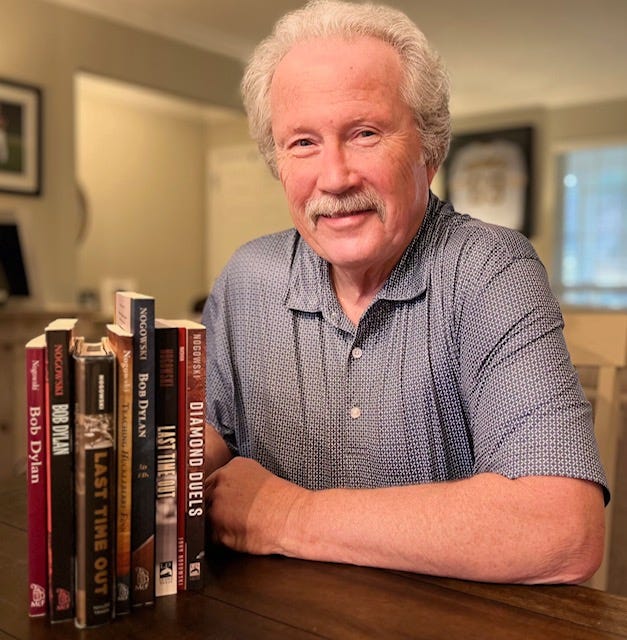
John Nogowski is the author of several books, including the forthcoming comprehensive book on Neil Young for McFarland and Co. — “Neil Young: A Descriptive, Critical Discography and Filmography.” He previously did three editions of “Bob Dylan: A Descriptive, Critical Discography and Filmography, 1961-2022.” He’s currently at work on a similar volume on Bruce Springsteen. He’s also written two books on baseball - “Diamond Duels,” a deep dive into the game’s historic matchups and “Last Time Out,” a collection of stories about the MLB finales of the game’s greatest players. These and his other books are available on Amazon and locally at Tallahassee’s Books A Million, Barnes & Noble and “The Bookshelf” in Thomasville, Ga. He started a Substack in May of 2024 and this is post 621. All free!
My Book Club also saw Elvis together and absolutely loved it!!!
“Epic” and beyond! I also saw Elvis the year before he passed away. He stopped the concert to tune up the performance for the audience. The scarf around his neck was given to fan after fan and then replaced by the designated scarf carrier to the King! What a performance artist!