
Hemingway made the cut
Self-editing "Big Two-Hearted River" fixed his story

Whether it’s karma, fate, destiny or just a matter of taste, our greatest writers have always been reticent to explain their magic. Or to tell us what strings they were pulling and why they were yanking them.
“Here’s why I had this character do this. I included this description because… I had to end the story this way because…” Stuff like that.
Maybe they couldn’t really explain it, other than to know what was, instinctively, the right thing to do. And let’s face it, explaining WHY a story works just isn’t that easy. I recently wrote about the great Anton Chekhov story “The Lady And The Little Dog” which no less an expert than Vladimir Nabokov explained was a story that did just about everything wrong but was nonetheless, one of the greatest stories of all-time.
Fortunately, Ernest Hemingway was in a chatty, explanatory mood when he wrote a letter to Robert McAlmon, one of his friends from his early days in Paris in November of 1924. It was two months after he’d submitted the stories for his acclaimed collection “In Our Time,” and he wrote to McAlmon about an editing decision he’d made about his long, deceptively crafted short story “Big Two-Hearted River.”
The lengthy story, a subdued yet very specific account of a fishing trip, was a story where nearly everything significant happened beneath the surface. If you needed an example of Hemingway’s famous “Iceberg” theory, where the actual events of the story are just the tip of the iceberg, you couldn’t do better than “Big Two-Hearted River.”


As Hemingway later explained his intent in a proposed Introduction to a collection of his short stories that never got published, “A few things I have found to be true. If you leave out important things or events that you know about, the story is strengthened. If you leave or skip something because you do not know it, the story will be worthless. The test of any story is how very good the stuff is that you, not your editors, omit. A story in this book called “Big Two-Hearted River” is about a boy coming home beat to the wide from a war. Beat to the wide was an earlier and possible more severe form of beat, since those who had it were unable to comment on the condition and could not suffer that it be mentioned in their presence. So the war, all mention of the war, anything about the war, is omitted.”
But not at first. In the process of writing the story, apparently Hemingway had originally included a lengthy interior monologue with Nick, had him talking about the war, how it impacted him and so on. Then, after re-reading the story and thinking about it, he wrote to McAlmon about his self-editing decision.
“I have decided that all that mental conversation in the long fishing story is the shit and have cut it all out,” he wrote. “The last nine pages. The story was interrupted you know just when I was going good and I could never get back into it and finish it. I got a hell of a shock when I realized how bad it was and that shocked me back into the river again and I’ve finished it off the way it ought to have been all along. Just the straight fishing.”
So, for example, when Hemingway takes great care in describing Nick patiently, intently watching the trout in the stream finding a way to hold themselves steady against the rush of the water, he’s not just talking about a would-be fisherman thinking of what might make a good dinner. He’s going much deeper. How would Nick hold himself steady after what he’d been through. Again, not mentioned.
Hemingway actually had two parts to the long story and, understanding the depth of his intent helps you grasp the opening perhaps in a different way than you might have otherwise. The story opens like this: “The train went on up the track out of sight, around one of the hills of burnt timber. Nick sat down on the bundle of canvas and bedding the baggage man had pitched out of the door of the baggage car. There was no town, nothing but the rails and the burned-over country. The thirteen saloons that had lined the one street of Seney had not left a trace. The foundations of the Mansion House hotel stuck up above the ground. The stone was chipped and split by the fire. It was all that was left of the town of Seney. Even the surface had been burned off the ground.”
He arrives in a town he used to frequent on the edge of the Michigan woods only to find it has all been burned to the ground. The saloons, the hotel, gone, even the stone chipped by the fire. Something awful, a fire in this case — not a war — has transformed this place.
Perhaps this was his dream place, the site he kept in his mind when lying in an Italian hospital trying to recuperate from his wounds, or at night alone, out on the battlefield. Now to finally arrive and find this place, too, has been altered, scarred, like him. He’s not there to go to the town — there’s no town to go to — he’s there to fish, to get away from it all. But as those subtle shifts in the story show, he can’t quite get away from it all. And he won’t. It’s delicately, craftily written. It’s not a story to breeze through.
Would it be a help to readers if we had more writers explaining their intent, really getting into the nuts and bolts of creating the text? It’s hard to know for sure. We don’t have many examples like Hemingway’s.
What if we had Herman Melville explaining his mysterious “Bartleby The Scrivener” tale? Or would that spoil it, steer us in a direction that he didn’t intend? Maybe it’s better to just write it and if it lands, it lands.
With “Big Two-Hearted River,” reading Hemingway’s letter to McAlmon did seem to sharpen our focus as it seemed to sharpen his. It’s fascinating that we have that letter and with that particular story and self-edit, Hemingway grasped something about his art on his own.
Later, in that Introduction, he explained that the river he based the story on was the Fox River, near Seney, Michigan.
“The change of name was made purposely,” he wrote, “not from ignorance or carelessness but because Big Two-Hearted River is poetry…”
He might have a point.
HERE’S THE PDF OF THE FULL STORY
https://www.libraryofshortstories.com/storiespdf/big-two-hearted-river.pdf
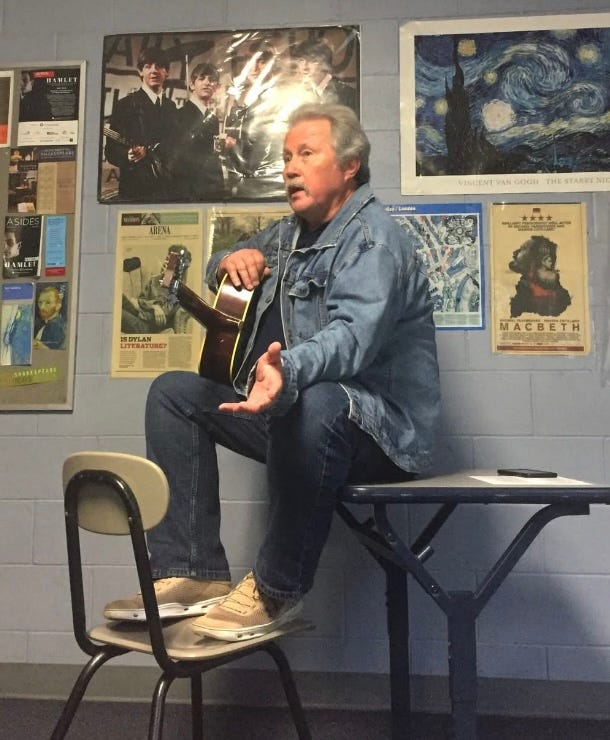
Author John Nogowski taught Ernest Hemingway’s short stories for a dozen years in college and high school classrooms. Though many of his greatest short stories were written over 100 years ago, I found my students consistently loved his work and responded well to stories like “Hills Like White Elephants” and “A Clean Well-Lighted Place” and “Fifty Grand.” I’ve written often about Hemingway’s work and my experiences teaching on my Substack, which celebrated my 700th post yesterday. I’ve written a book about my teaching experience with Mark Twain’s “Adventures Of Huckleberry Finn” as well as books about baseball - “Diamond Duels” and “Last Time Out” and popular music - “Bob Dylan: A Descriptive, Critical Discography and Filmography” and “Neil Young: A Descriptive, Critical Discography and Filmography”. I’ve been writing a Substack since May of 2024 and have been a regular contributor to the Hartford Courant. My books are available on Amazon.
I see similarities in editing stories and in visual art. Often it's more interesting to insinuate something rather than just blatantly put it in.
Great post which motivated me to read "Big Two-hearted River." It's not for everyone but there's no better example of Hemingway's Iceberg theory. My favorite Hemingsway story is "The Short, Happy Life of Francis Macomber."