
Making the team - or not?
On monumental outfield decisions at 16

The decision, which would have a monumental impact on the entirety of my life and career was made where all such decisions should be considered - standing in an ill-fitting baseball uniform in the outfield behind Nashua’s Holman Stadium sometime in the spring of 1969.
That was where Nashua High head baseball coach Charles “Buzz” Harvey shipped all the sophomores who didn’t figure in his plans for the season. It was sort of a baseball purgatory. You weren’t on the varsity - didn’t really expect to be. Nashua High was a huge school, my graduating class was over 1,000, supposedly one of New England’s largest high schools. Or so we were told.
This was not exactly comforting news to the 16-year-old me, who had recently been bitten by the baseball bug. Sure, I played all the time in our neighborhood but I had never played Little League - there was no such thing in Brookline. Now, I was just one of a couple dozen hopefuls, trying to make the team at this enormous school.
For some of my teammates, who had junior high success or maybe a brother who’d preceded them, these guys had played Little League together and knew one another. And with the coaches, there was the chance of some familiarity, some name recognition. “Ulbin. I coached your brother, Gary.” None for me. I was just a kid from Brookline, twenty five minutes out of town, often hitchhiking home after practice.
So when Buzz’s trusted assistant Tony Marandos, who we mostly knew as NHS’s basketball coach for many years, gathered us together, I wondered, what would it take to make the team? He was an older man with wobbly knees and walking was difficult for him. He was soft-spoken, never yelled, unlike just about every other coach I’d seen.
How did I match up? What can you tell from batting practice? Or catching fly balls? How was Marandos going to pick his team? When he picked guys to play positions for a scrimmage, did that mean they had the job? Nobody knew me. And really, I didn’t know, either.
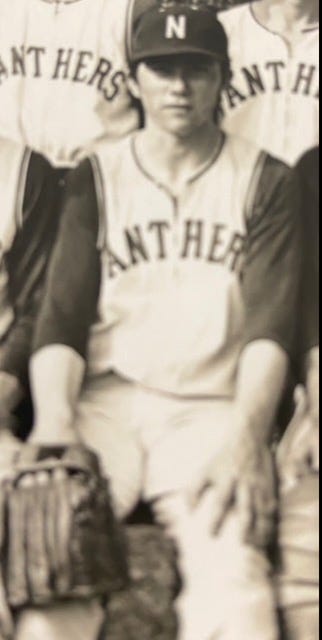
But I did notice one thing. Watching us throw from the outfield, it seemed as if I had the best arm of the bunch. That was, as the scouts would say, my No. 1 tool. Maybe my only one. I fielded fine - easy chances - and I swung the bat as well as anyone in batting practice. But nothing that would separate me, I didn’t think.
So what do you do in a situation like that? I’m not sure what the recommended remedy would be but for me, it was this. I lied. On Day Two or Three, I walked up to Coach Marandos and told him I pitched. He smiled.
“You pitch, huh? OK. Let me see you throw.”
Problem. Pitchers, at least in those days, had to have a windup. Trying to improvise one in the middle of a major lie, well, let’s just say it made things immediately clear.
Marandos just smiled. “We’ve got to work on that delivery,” he said. Then walked away.
What did that mean? For me, it meant one thing. Now, I was a pitcher. I didn’t have a windup and hadn’t thrown in a game yet and had to teach myself a curveball by bringing the Sports Illustrated book on baseball to the Brookline Ballpark and figuring it out by myself. But now, I was a pitcher.
And it sounds corny to say it, especially now when I think of how little went into that long-ago decision, but it changed my life. Now, I was an athlete, part of a team and so loved sports that it became my world, becoming a sportswriter for 25 years, writing books about the damn game and much later, a dad and coach, watching my son go all the way to the major friggin’ leagues. If there had been a way to spin the dial ahead that afternoon in the Holman Stadium outfield, there’s no way I could have imagined what ended up happening.
Over the next few practices, Marandos worked with me, teaching me to how to use my whole body to throw, a big leg kick and follow-through, adding velocity and I hoped, accuracy to my every pitch. It was a pitch now, not a throw any more.
Guess who was the starter for our season opener? And who came within an out of throwing a no-hitter against Fitchburg, my mother’s old hometown, while she was watching in her Impala across the street.
“I was talking to the bus driver,” she told me on the way home. “And he said, “I like the way that kid was pitching for Nashua.”
“That’s MY SON,” she said as if the bus driver’s praise was more important than my one-hit shutout. Moms.
It became a one-hitter when our left fielder, Jim Robbins, suddenly decided he wanted to talk to our shortstop and was playing way in, when what should have been the last out - a fly ball to left field that, naturally, dropped right where he should have been playing.
I was so pissed, I struck out the next batter on four pitches. It should have been three but the ump missed the 0-2 heater at the knees. I snapped my glove at the throw back from my catcher after that miss and took the sign - though I didn’t really need one at that moment - and cut loose with the same exact pitch, about ten MPH faster.
“STRIKE THREE!”
For the only time all season, Coach Tony Marandos sprung those creaky knees off the bench, stood up and let out a yell.
“That’s the way to pitch!”
I blushed. Can pitchers blush?
A couple years later, pitching for first-year coach Charlie Mellen’s Nashua High varsity, now a senior, I was the first guy out of the bullpen in our second game of the season - our ace threw a complete-game no-hitter in the opener - hurriedly bringing me in on a chilly Sunday afternoon with us trailing, the bases loaded and two outs. The batter at the plate had hit a 400-foot triple in his previous at bat. No pressure.
I wound and threw and Manchester Memorial’s Stan Pinkus hit a mile-high popup to first. He was almost to second base by the time it was caught. We came up and got seven runs. I got the win. Pitchers do that sort of thing, you know.
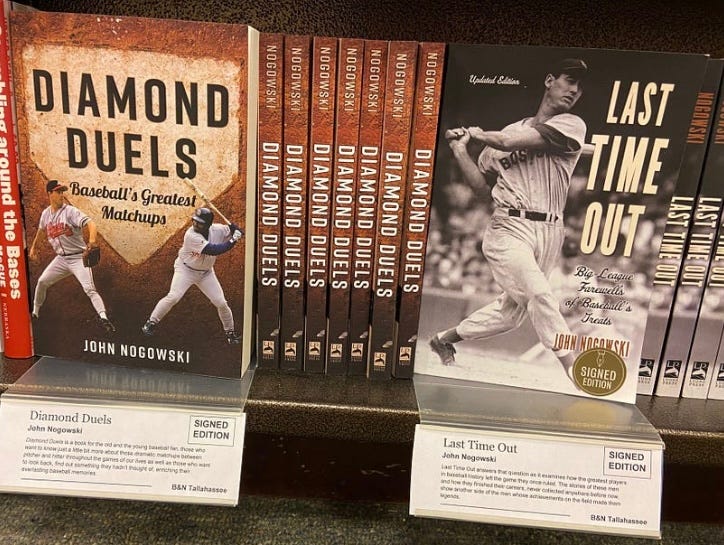
Author John Nogowski’s two baseball books, “Last Time Out” about the MLB finales of the game’s greatest players (and my son’s MLB debut with the St. Louis Cardinals!) and “Diamond Duels” a deep dive into baseball’s greatest pitcher-hitter matchups. Both are available on Amazon or by order at your local bookstore.
Such a cute little kid
John, I have a similar near no-hitter story from The Babe Ruth League. Pitching for the Pirates I had a no-no for 6 2/3 innings. Then, an easy pop-up to right that required Tommy Shubelka to move 3 steps to his right. Unfortunately he could only manage 1, tripping and watching the ball fall inches away!