
On being a "traitor"
How do you dare define the word?

The word, a single word, just jumped off the page at me. “Traitor.”
It was a word that appeared in a column written by Charles P. Pierce for Esquire and I seem to recall it had to do with removing statues of Southern heroes.
I’d read Pierce before, in fact, actually saw him in action once, both of us covering a Boston Bruins’ game. In those days, we had to use Radio Shack computers, “Trash 80’s.” (Well, that’s the family-oriented version) We used them to write our stories and then attempt to send them back to the newsroom electronically.
On deadline, Pierce’s computer opted not to cooperate. Whether it was his word choice, just an “Operator Error” - which is what the IT guy always used to tell me when my story wouldn’t go through - or plain old fate but Pierce started slamming and banging and swearing at the pitiful Radio Shack computer so that it shook up both the press room and that poor computer. It certainly never lived to send another story.
Many years later, reading a Pierce essay in Esquire magazine — indeed, he’s a long way from the press room at the old Boston Garden — that phrase, “the traitor Robert E. Lee,” made me stop in my tracks. I’d never thought of him that way.
My New Hampshire education and my own reading taught me that yes, Lee commanded the Confederate troops in the Civil War and also that, while he was tops in his class at West Point and President Abraham Lincoln offered him the chance to lead the Union Army before the war began, instead, Lee decided to defend his slave-holding state of Virginia.


The way we see things now, it’s hard to argue with Pierce’s description. Lee went against the sitting government, didn’t he? No matter how sincere the Confederate general might have been in his love for his home state, that was wrong. But a traitor?
This idea popped into my head the other day when I re-watched the great film “All The President’s Men” where the Washington Post’s Bob Woodward and Carl Bernstein uncover the deeds of a remarkably corrupt Nixon Administration. Their investigative stories ultimately force Nixon to resign and many of Nixon’s staff wound up in prison.
Woodward’s investigation very likely would have stalled (that’s exactly how he says it in the film) were it not for the deep background confirmations of his off-the-record source or “Deep Throat.” An inside source who was later revealed to be Mark Felt, then the No. 2 guy in the Federal Bureau of Investigation.
In the film, Woodward has to meet Felt in a parking garage at 3 a.m., which is actually what happened. I looked up how many times the two met. Six, the Internet said.
Then I saw the damndest thing. They actually put up a historical marker at the parking garage (I believe the garage is torn down now) to commemorate Woodward and Felt’s clandestine meetings. The No. 2 guy in the FBI, evidently appalled at the lawlessness and corruption he saw in the White House and the Nixon Administration, chose to help out a newspaper reporter and get the truth out there. That’s what those meetings were all about.
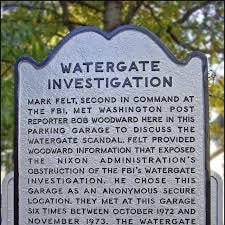
Was Felt a traitor? There’s no doubt that many in the current administration would suggest that. You may remember in his initial turn at 1600 Pennsylvania, the President met with FBI Director James Comey and the first thing he asked for was this: “loyalty.” Comey refused and was later dismissed. Was “loyalty” the reason?
How do you define “traitor” these days, anyhow? Are you loyal to the Constitution or to whoever happens to be in the Oval? That would seem to be an easy question. I’m not sure it is any more.
In his stage show “Mark Twain Tonight” where actor Hal Holbrook impersonates the great writer, he used to talk about patriotism and loyalty.
Near the end of the show, Holbrook (as Twain) would huff himself up for this big pronouncement and make the dramatic boast: “Our country: Right or Wrong? Any man who fails to shout it, is a traitor.”
“Traitor.” Hmmm. That word again. What does it mean? I guess it depends on who you ask.
John- I respectfully have to disagree with your posting today.
I look back at how history was taught in the mid-1960’s and now recognize how much was left out. For example, Woodrow Wilson was described as a progressive President who tragically “worked himself to death” trying to get the Senate to approve entry into the League of Nations. It’s only been in recent times that some of the baggage he carried from his youth in the South during the 1800’s has been publicized. Check out the controversy at Princeton recently (where he was president of the university). It can be said that he was a product of his times. It shouldn’t be said that he was a great human being.
Robert E. Lee was always described as a heroic figure in the history books 60 years ago. I think, in retrospect, that description carries over from the South’s post Reconstruction attitudes to the Civil War. I’m sure you remember how Southern politicians described the conflict as “the War between the States.” That implies a conflict between two sides of differing views, both sides having equally legitimate views. Somehow I doubt that many people in the North in 1865 thought of Lee as a heroic figure.
Was Lee a traitor? I would say yes. I believe that West Point graduates in the 1800’s took an oath to the Constitution and the U.S. What’s more, it’s not as if there wasn’t anti-slavery information available to anyone paying attention in the 1850’s who resided in the North (which Lee did). Was he a product of his times? Absolutely. But he certainly engaged in, at the least, traitorous activity.
As for Felt, this may sound inconsistent, but I would not describe him as a traitor. Felt exposed illegal behavior (and just like anyone in the military who has taken the oath isn’t required to follow an illegal order). I would guess that Felt thought that the only way to expose this behavior was to act secretly as an insider.
As I see it Felt acted to expose illegal activity. Lincoln offered Lee the position of leading the Union Army. He declined the offer because he didn’t want to fight his native Virginia. He could have resigned his commission. Instead he chose to lead the rebellion.
"The tree of liberty must be refreshed from time to time with the blood of patriots and tyrants. It is its natural manure." “God forbid we should ever be 20 years without such rebellion.” Jefferson on Shay’s Rebellion 1787.
Lee is no more or less of a traitor than Washington, Jefferson, and Adams. None of which, should ever be compared to Nixon, Felt, or any other political operative.