
"Tangled Up In Blue" - Perfect!
Of course, Bob had a revision in mind...

A writer I know put it this way: “Rarely has Bob Dylan matched music and words so aptly as he has on this song. The tale of interrupted love is perfectly matched by the melody, built around a two-chord riff. As the riff builds, the song begins to gather momentum as the chorus approaches - like the buildup of the relationship. Then comes a succession of quick chord changes - symbolizing the sudden, abrupt shifts in his life - and he delivers the title line, a perfect metaphor for his situation. He then returns to the opening riff, back to the beginning - the same old problems all over again. And on the song goes. His closing harmonica solo, trying to dance in the face of these heartaches, is almost heroic.”
That was me. In 1995 in the first of three editions of “Bob Dylan: A Descriptive, Critical Discography and Filmography”
“Tangled Up In Blue,” the opening track on Dylan’s monumental “Blood On The Tracks” album, is, to my estimation, as perfect a song and performance as anything the old guy has ever put on vinyl. Being Bob Dylan, of course, it was only a matter of time until he had to come up with something to steer us in another direction, a comment to make it clear that HE didn’t think he got it right - even if all of us all over the damn world sure did.


This is one of the infuriating things about him. Also something endearing. I can’t explain that. Can you?
“I always wanted it to be the way I recorded it on “Real Live,” he told Bill Flanagan in “Written In My Soul.” “But there was no particular reason for it to be that way, because I’d already made the record. That was another of those songs where you’re writing and you got it, you know what it is about, but half of it you just don’t get the way you wanted to. Then I fixed it up and now it’s where it should be.”
To me, that’s classic Bob Dylan Bullshit. If you listen to both versions of the song - they are included here - and you BUY what he’s selling, well, we must have different sets of ears, standards, values and taste.
If you’ve followed Dylan’s career, you know that he first recorded those “Blood On The Tracks” songs in New York and had played them for a bunch of folks in the meantime, supposedly including David Crosby, Neil Young and Stephen Stills. It was Stills who commented afterwards that Dylan was a great songwriter “but he’s not a musician.” Those versions eventually came out on The Bootleg Series “More Blood, More Tracks.” Some people prefer those to the “Blood On The Tracks.” Not me.
But there was something about those New York recordings that made him hesitate about releasing them. Returning to Minnesota for the holidays, he decided to re-record some of the songs, happily, including “Tangled Up In Blue” at Sound 80 Studios in Minneapolis. And the story goes that after he’d re-recorded a version of the song, he played it back for the studio musicians in there and asked guitarist Kevin Odegard what he thought. Odegard famously replied that the version was “passable.” Oooh…A chill must have gone through that studio. You’re telling BOB DYLAN a song he just performed was, uh, well, sort of, kind of, you know, uh, passable.
Odegard also suggested changing the key from G to A. And Dylan said “Let’s try it.”
Dylan’s response was the remarkable version we heard on “Blood On The Tracks.” Which confirms my thinking that ol’ Bob does need to be poked from time to time. Like, by Daniel Lanois, say, if the stories about the recording of “Time Out Of Mind” and “Oh Mercy” are on the money.
Which brings us back to why Dylan acts this way. After “Time Out Of Mind” wins a Grammy Award for Album of The Year for the 56-year-old Dylan - a pretty remarkable achievement any way you slice it, 25 years later, Columbia releases “Fragments,” a collection of “Time Out Of Mind” outtakes and a few live tracks that, essentially, give us a different way of hearing the album as if Bob wasn’t satisfied with the Grammy and everybody hearing what Lanois cooked up.
According to what we find online, mix engineer Michael Brauer was asked to “strip away Lanois’ heavily processed, “murky” atmospheric effects to present the songs exactly how the musicians sounded playing together in the room.”
Brauer told Rolling Stone that he did this gingerly. He explicitly informed Dylan's team, "I'll do this, but I'm not reinventing it. I don't want it to be a completely different thing," noting it would be the first record he would turn off if he went "crazy with it.”
So, Bob, you win a Grammy. And all these years later, you poke your manager Jeff Rosen or Steve Berkowitz to get somebody to give another listen to the outtakes and come up with an altogether different presentation of these classic songs. It had to be Dylan’s idea, don’t you think?
And listening to the box set, it is great, so I have to say I’m glad Brauer did what he did. But where do you get the idea in the first place? I guess you have to be Bob Dylan.
HERE’S THE CLASSIC STUDIO VERSION OF “TANGLED UP IN BLUE”
HERE’S THE BOB DYLAN RE-WRITE ON “REAL LIVE”
Author John Nogowski first wrote about Bob Dylan’s “Planet Waves” for the Rivier College newspaper called “The Perspective.” At that time, he had no idea that all these years later, he’d still be writing about Dylan, would have done three editions of a comprehensive book about his career and would have gone to see him ten times in concerts all over North America. He’s written about him often in his free Substack, going on Year Three, and has shared many of the articles with Karl Erik Andersen’s wonderful website “Expecting Rain.” He’s also written a similar comprehensive music book on Neil Young, due next year. A former sportswriter, he’s written two books on baseball - his son is a former major-leaguer - “Diamond Duels”, about baseball’s historic matchups and “Last Time Out” a collection of stories about the game’s greatest players MLB farewell. All are available on Amazon.
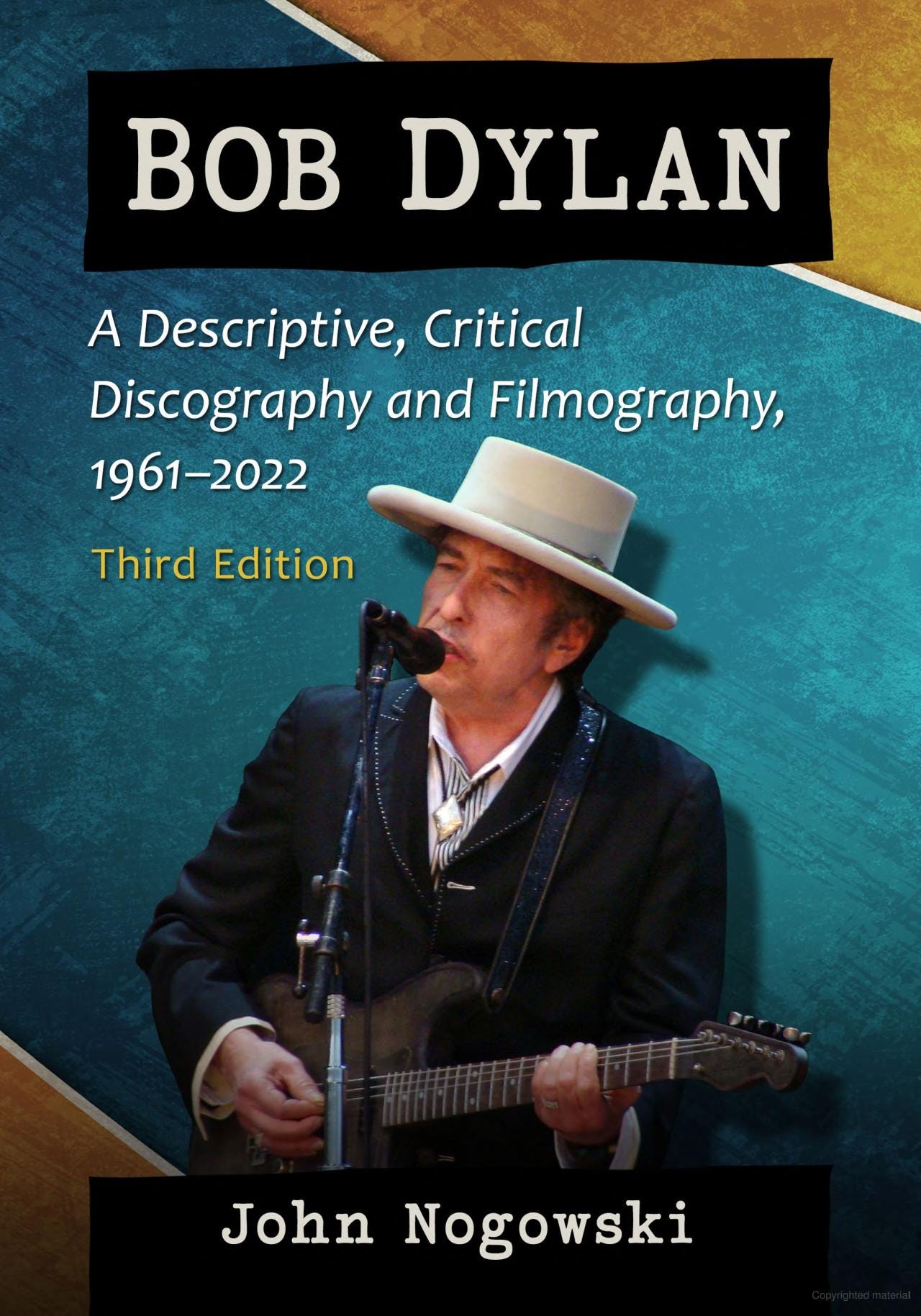
The most recent of three editions of the book. It includes “Rough And Rowdy Ways.”
A masterpiece!!!
Fun piece of unrelated music trivia for you.
The night that Gram Parson’s and Emmylou Harris met for the first time was at the house of Walter Egan, of Magnet and Steel fame.