
Watching the master (Chekhov) work!
George Saunders and an old teacher look at "The Lady With The Little Dog"

One story that always seemed to defy just about all the rules of storytelling is Anton Chekhov’s “The Lady With The Little Dog.” He wrote it in December of 1899 for “Russian Thought” (translated) and supposedly he wrote it in Yalta, a resort town.
Yalta was important to me in my own writing life. In an early Substack, I recalled how our World History teacher Mr. John Wright sprang a surprise one-question history essay (on the day of a hugely important baseball game I had to pitch) asking us to write an essay about “The Atlantic Charter,” something we were supposed to have read about the night before.
Like the rest of the class, I chose not to. When I saw the lone question was about the ramifications of “The Atlantic Charter,” all I could remember was a photograph of Winston Churchill, Joseph Stalin and Franklin Delano Roosevelt, who looked so old and tired, it was like he’d swum all the way to Yalta himself. He died two months later.
So I wrote a whole page and a half, making stuff up and was the only one in the class to pass. A B+. Mr. Wright praised my writing skills, hence the B+, but warned me to never do that again.
This story starts in Yalta and I can safely say, Chekhov’s technique here will, I suspect, impress you as it did my AP Literature students when I, somewhat hesitantly, presented it to them some years ago. Chekhov is subtle, devious almost, a master. You can almost sense the man behind the pen, chuckling to himself how this little shift or detail will turn this story. He was also a doctor so he knew how the body worked. He also understood human nature, perhaps even better. “The Lady With The Little Dog” is to me, his greatest work. At least, it truly connected with me. And my students.


I want to share my analysis here with one of our great writers. I can never thank George Saunders enough for allowing me to include his Introductory essay “The United States Of Huck” in my own book on my experiences teaching “The Adventures of Huckleberry Finn” at an all-black school in Gadsden County. Originally, it would have cost me $5,000. Saunders simply gave it away. (Gulp) (It’s on Amazon!)
Initially, I was disappointed that he did not include “The Lady With The Little Dog” in his terrific collection of Russian short stories he taught at Syracuse - “A Swim In A Pond In The Rain” which I also highly recommend, even if you’re not a teacher. But he did get to it on his Substack and I’ve excerpted some of his comments here. It’s a story that’s worth examining several times, one that, I suspect, will leave you wondering, just like after a magician’s closing trick, how did he do that?
Saunders opens his analysis of all story writing talking about expectations: “The writer makes an expectation, and then fulfills it, but not too neatly. For example: Scrooge. Once he’s described as “a squeezing, wrenching, grasping, scraping, clutching, covetous, old sinner! Hard and sharp as flint,… secret, and self-contained, and solitary as an oyster”…we expect (we can’t help but expect) that the story is going to be about a change, from that state to another.
“If not, it’s just an anecdote: “I once knew this really stingy guy who stayed that way.” But if he does change, the story becomes meaningful, by saying: “Here is how a stingy person might become more generous…” And that story will be about, in turn, transformation, and what makes people stingy in the first place. So that story (Charles Dickens’ “A Christmas Carol”) will have a theme, and character development, and a political stance, and all of that – but it got those things by simply tending to the expectations it had created.
“Stories create a baseline reality and the very fact that that reality is in a story means that we expect that baseline reality to change. And structure and plot and all of that arise as we attempt to notice, and then attend to, the expectations we have (perhaps even unwittingly) created.”
So, you might say, we’re writing in our own heads as we’re reading. Where is he going with this? Why should I keep going? One technique Saunders uses is asking his students to read a single opening page of a story. Then stop, critique it. Where is this going? Why do you think that? Why did the writer begin there?
In the “The Lady With The Little Dog,” we meet Dmitry Gurov, a married Russian businessman on the make in Yalta, a resort town where people try to get away. He spies Anna and her dog and likes what he sees. “If she’s here without her husband, it wouldn’t be a bad idea to make her acquaintance.”
We get it. He’s going after her and our expectation is it’s either going to be great, naughtily exciting for both - (What happens in Yalta stays in Yalta) or bad for one and good for the other.
We know this type. We’ve seen him in a hundred movies. Maybe we know him. Maybe it’s us. (Not I, said the little red hen!) As Saunders explains: “He is a guy unhappy in his marriage, looking for a chance to cheat. And he’s done it many times before (“repeated and bitter experience had taught him that every fresh intimacy…inevitably developed…into a problem.”) And yet, “every time he encountered an attractive woman…the desire for life surged up in him.”
He’s a guy who can’t say no. Or won’t. So the two meet, they flirt and we see Gurov has game. Saunders notes: “Anna is charmed and impressed with Gurov, and so are we – we believe he is charming because we’ve just seen him charm her. Already he’s more interesting to me. Although he may be a serial philanderer, he is now, also, something else: attractive.”
But back in his room, he acknowledges her attractiveness but also notes: “And yet there’s something pathetic about her.” Which would certainly hurt Anna if she knew he thought that. Does that make her an easier target, though?
A little further on, they kiss and go to her room and as things are about to happen, Gurov reflects back on his previous batting order, shall we say, wondering if she’ll hit cleanup or at the bottom of the lineup?
Saunders explains: “Then, on pages 74-75, we get that startling, somewhat cynical, crazily frank taxonomy of his past affairs, underscoring that this is far from his first time. He breaks all of the women with whom he’s had affairs into three categories: 1) good-natured ones, who were grateful afterwards; 2) pseudo-intellectuals like his wife, who made love insincerely, mistaking it for something more that it is; and 3) beautiful, frigid women, who really liked doing it, because they understood it as purely physical, and whom he groups with snakes.”
As a writer and as a reader, doesn’t this push Gurov into a corner with a dunce cap? Granted, it was 1899 and social roles might be very different for women in Russia. But if you think this is a calculated push, you ain’t seen nothin’ yet.
They complete the act. “She’s timid and has the awkwardness of youth,” he puts on his mental scoresheet. Immediately, as we anticipate, she’s filled with regret. “It’s not right and you don’t respect me now.”
So what does Gurov do? He sits down, cuts himself a nice fat slice of watermelon and eats it. In silence. For at least “half an hour.” Could Chekhov push him any farther into that dunce hat corner? Make the hat bigger?
And yet, we learn she married young (and poorly) and maybe had the same motive at Yalta as Gurov, whether she wanted to admit it to herself. That does change things, doesn’t it? Or does it?
Chekhov has so skillfully drawn these two, we’ve signed on for the ride and a ride it is. The affair continues “every day at noon” until she is summoned home. Gurov says he feels “moved and sad, and felt a slight remorse.” Why? Because, in the whole, he had deceived her. She thought he was kind and exceptional and high-minded but all along, though good to her on the surface, he had kept his distance, via light irony.” And maybe the watermelon break, too.
As a reader, we can see the story doesn’t end. Something must have changed. Is it, after all these flings and arrows, Gurov? Chekhov, of course, completely understands that’s exactly what we’re waiting for, he’s rope-a-doping us. After returning home to Moscow, it’s cold and winter and Chekhov drops a three-letter word that rings like a bell. “He had believed that in a month’s time Anna”…would be forgotten….“but…it was all clear in his memory as if (they) had only parted…the day before.”
In a story written in beautifully rich soft focus, everything suddenly and sharply comes into view thanks to those three little letters. There are pages to go. What will happen?
Gurov can’t help himself, he goes to see her, gets himself a hotel where everything seems gray - the color of her favorite dress - and he notices – subtle bit of Chekhov imagery – a small statue of a horseman who has lost his head. Hmmm.
He goes to Anna’s home and finds it surrounded by a fence, “long, gray, with spikes.” “You could flee from such a fence,” thought Gurov.”
We get it now. He’s hooked. He learns there’s a local theater showing, makes a guess that she’ll be there. She is, they furtively meet (a remarkably skilled scene by Chekhov) and Saunders notices the artist at the very tip top of his game. There is a lot of built-in tension here, a public place, her husband is there, it’s totally out of Russian cold and blue and you feel as if you’re eavesdropping.
As Saunders notes: “…reading a story like this sets a high bar and reminds us that a work of art is great to the extent that it alertly responds to itself, and that this can only happen when the writer takes responsibility for all of it and tries (again and again) to move through it in a state of high attention. The “deciding” may amount to simply “noticing (at some level) and blessing the work as it stands.” But, still, the deciding has to happen. That’s how we feel the artist there, in all his or her glory, behind the work.”
So we know Chekhov on his game. He’s brought us here, they still long for one another, both are married, how does this wind this up? Is Gurov in, dare I say it, LOVE?
They carry on for a few more months. Then, meeting in a hotel - Gurov is late - he finds her in tears. Chekhov writes: “She wept from emotion, from her bitter consciousness of the sadness of their life; they could only see one another in secret, hiding from people, as if they were thieves. Was not their life a broken one?”
Unlike the watermelon moment, after all this time spent together, he consoles her. And catches a glimpse of himself (a brilliant Chekhov move!):
“His head was beginning to turn gray, And it seemed strange to him that he had aged so much in those last years, had lost so much of his good looks. The shoulders on which his hands lay were warm and trembled…Women had always taken him to be other than he was…and not one of them had been happy with him…And only now, when his head was gray, had he finally fallen in love as one ought to – for the first time in his life.”
It seems to arrive as a gift from above, a man who so often sought and secured intimacy but it mattered no more to him than a slice of watermelon. Now, though, it inescapably did. And he didn’t want to escape. And neither, it seemed, did she.
“It was quite obvious to him that this love of theirs would not soon come to an end, and that no one could say when this end would be. Anna Sergeyevna loved him ever more fondly, worshipped him, and there would have been no point in telling her that one day it must end. Indeed, she would not have believed him.”
So how do things end? By not ending, pointing to a whole other set of circumstances that have to be worked out. But Chekhov, remarkably, I think, trusts his readers enough for them to believe in the theme of this story - love. And that it will win out in the end.
Saunders describes the finish this way:
“Then they discussed their situation for a long time, trying to think how they could get rid of the necessity for hiding, deception, living in different towns, being so long without meeting. How were they to shake off these intolerable fetters?” (Saunders: This is nice – the story, and the lovers, are asking exactly the questions we’re asking – this feels like a sort of summary, a little catching of the breath.)
“How? How?” he repeated, clutching his head. “How?” (I like this because, for the first time, it’s Gurov who’s overcome with emotion, who’s being a tad dramatic.)
“And it seemed to them that they were within an inch of arriving at a decision, and that then a new, beautiful life would begin. And they both realized that the end was still far, far away, and that the hardest, the most complicated part was only just beginning.”
What an ending! I can tell you that not only did I love the story, so did my students. I remember one student in particular - not one of my real scholars, I might add - who stood up at her seat when we finished the story and said in a loud voice, “Mr. Nogo, YOU HAVE TO KEEP TEACHING THIS STORY.”
So, I quietly gave thanks to Anton Chekhov. And to myself, for sharing this. And to the power of literature, going out to a bunch of high school kids who now have a goddamn good reason to believe in the power of love. Thanks, Gurov.
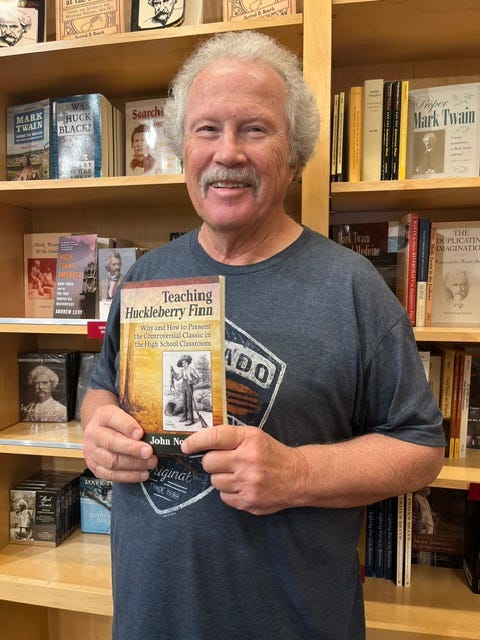
Here I am at the Mark Twain House with his book on teaching the Twain Classic. What a thrill it was to know your book is in Mark Twain’s old home in Hartford. In writing about the Chekhov story again, it reminded me once again how much fun I had in the classroom. It’s shame that schools across America have such a hard time finding - and keeping - teachers. I’ve also written books on Bob Dylan: Three editions of “Bob Dylan: A Descriptive, Critical Discography and Filmography” and a forthcoming book on Neil Young “Neil Young: A Descriptive Critical Discography and Filmography” and am at work on a similar book on Bruce Springsteen, who I believe is going to be a big star. I’ve written two books on baseball - my son is a former major-leaguer - “Diamond Duels” about the game’s historic matchups and two editions of “Last Time Out,” about the MLB farewells of the game’s greatest players. It also includes, in the final chapter, my son’s first MLB game for the Cardinals. I’ve been writing a free Substack since May of 2024, headed into Year Three and have been a regular contributor to the Hartford Courant, today in fact - about Bob Dylan’s “Chimes of Freedom.”
Excellent post. Chekhov is truly everything I want to be as a short story writer. There's no one else that understands the reader journey and how to make you feel things in such a short space.
And Saunders is such a legend. I'm not surprised to hear you say he gave you that for nothing. I've learned so much from his story club (and that book on the Russians). No doubt his way of thinking and picking apart stories is what I'm trying to achieve (at no where near his level!).
My English teachers were some of the most important people in my life as a teen (even though I dare not admit it at the time...). Why teachers don't get more money and more love baffles me.