
What do you mean, trivia?
The art of remembering useless information

THE MONDAY READER
(Since this is a longer post, including the magical profile the great A.J. Liebling did on the young Cassius Clay and this fight, I thought I should explain and encourage you to read him. Hilarious. Did you know “ventriflexions” was another term for sit-ups? Thanks, A.J. )
EDITOR’S NOTE: No psychiatrists have been consulted in the writing of this Substack.
As far as I know, there is no logical explanation for our feeble brains’ capacity to remember what to most of the rest of the Western World would consider pointless. By this, of course, I mean, trivia. Sports trivia.
You could make the point that if it weren’t for trivia, “Jeopardy” would never have happened. But sports trivia rarely — if ever — makes it onto the show. And if it does, it’s almost certainly accidental.
There may well be deep-seated psychological factors that make an individual’s brain retain some of these otherwise pointless ideas. Hard to say. You should, for example, remember certain days and events — birthdays, anniversaries, etc. — in place of who made the last out of the 1967 World Series but that doesn’t mean you will. Trying to explain this phenomenon to the uninitiated (or otherwise normal) folks close to you is, well, literally inexplicable.
This may be a subtle disease that seeps into the mind of a sports devotee without warning. Last summer in Dallas, I was a presenter at the national SABR (Society of American Baseball Research) convention, a collection of nerd-leaning individuals who can — and often will — recite starting lineups from decades old baseball games, describe in painstaking (and pains-listening) detail when they caught a foul ball on a long-ago Wednesday afternoon in a near-empty ballpark.
Yet when I attended the Convention’s Baseball Trivia Showcase near the end of the event, I was simultaneously awed and frightened by the AI-like recall of the winner, whose lightning-quick responses to the most arcane of questions made one worry about his existence once the quiz-portion of his world had concluded.
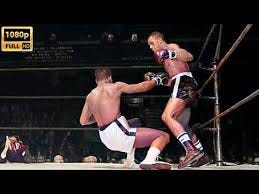
Sonny Banks drops promising heavyweight contender Cassius Clay to the floor.
Sure, I can tell you who made the last out of the 1967, 1975 and 1978 American League playoff games —- Carl Yastrzemski in each case — but generally speaking, I don’t think I go overboard. That was why, I think, in part, writing my “Diamond Duels” a little over a year ago was so much fun, finding out very specific but never voiced or written details about some of the game’s great heroes.
Stan Musial had 356 lifetime at-bats against Warren Spahn? WHAT? Whitey Ford never pitched a World Series Game Seven? HUH? He had 73 lifetime starts against the Chicago White Sox and only 42 against the arch-rival Boston Red Sox? ARE YOU KIDDING ME? (A 6.16 ERA in Fenway Park justified that little nugget.)
And for those of us who’ve spent time in press boxes over the years, possessing a few bits of trivia is almost a point of pride (and justification for spending so much idle time watching people run around on a field or court.) When there’s a quiet moment, a rain delay or when the action lags, these sorts of tidbits often tumble out.
Consequently, my absolute trivia all-time champ, a question that had stumped sports whiz kids from New Hampshire to New Orleans, was who were the four men to knock down Cassius Clay/Muhammad Ali? No fighter was ever as famous or as public as Clay/Ali so you would think if somebody put him on the seat of his pants, they would notice.
Everybody and his brother and sister remember Smokin’ Joe Frazier knocking Ali down in the 15th round of their first match in 1971, a knockdown that was depicted in more newspapers and magazines than the birth of JC, or so it seemed. A few fans of boxing will remember that England’s Henry Cooper’s flashing left hook flattened Clay in their first match and there may even be that die-hard, eager beaver who remembers that the Bayonne Bleeder, Chuck Wepner stepped on Ali’s foot as the same time he threw a sloppy punch in the direction of Ali’s chest and he fell. Referee Tony Perez called it a knockdown. (Yes, just double-checked. WHY did I remember that?)
But there was a fourth knockdown. And nobody, but nobody got it. For years and years. I got to believing in my trivial invulnerability. My wife often said I knew more useless information than anyone she ever knew and this was it, wasn’t it?
Then one day at the old Tiger Stadium, just a few weeks before they’d knock the joint down, there were a bunch of scribes sitting around yapping. The Tigers were changing pitchers or something, there was nothing happening at the corner of Michigan and Trumbull (Yes, I remembered that, too!) and I tossed my killer trivia question to the multitudes around me.
Heads bobbed, eyes blinked, hands went up. I was about to chalk up another win when a soft older voice from the fringes of our crew piped up.
“Sonny Banks,” he said, adjusting his glasses and rubbing his nose. “From Detroit.” It was George Puscas, erstwhile boxing writer from the Free Press who, I suspect, had heard of my trivial triumphs and lurked in the background at a baseball game just to upend me.
Heads turned, jaws dropped as we all turned to this frumpy guy with a little mustache and glasses, arms folded across his chest.
“I covered the fight,” he said. “I was there.”
Right then, I felt just like Cassius must have, resting on the seat of his boxing trunks in the middle of Madison Square Garden. It was a punch he never saw coming. I could relate.
NOT ONLY DID GEORGE PUSCAS COVER THE FIGHT, SO DID A.J. LIEBLING
Here’s an excerpt from a much longer — and delightful — article that I trimmed just a tad for length. (Sorry, A.J.) Notice how Liebling accurately anticipates Clay/Ali’s boxing style (“like a pebble scaled over water”) before Cassius hit the big time. How fortunate we were to have him there, to give us such a memorable coming attraction. If only he could have seen Ali-Liston II in Maine (1-punch KO)
A Reporter at Large
March 3, 1962 Issue FROM THE NEW YORKER – A PRESCIENT LOOK AT CASSIUS CLAY, THE FUTURE CHAMP
Poet and Pedagogue
February 24, 1962
When Floyd Patterson regained the world heavyweight championship by knocking out Ingemar Johansson in June, 1960, he so excited a teen-ager named Cassius Marcellus Clay, in Louisville, Kentucky, that Clay, who was a good amateur light heavyweight, made up a ballad in honor of the victory...At the time, Clay was too busy training for the Olympic boxing tournament in Rome that summer to set his ode down on paper, but he memorized it, as Homer and Gregson must have done with their things, and then polished it up in his head. “It took me about three days to think it up,” Clay told me a week or so ago, while he was training in the Department of Parks gymnasium, on West Twenty-eighth Street, for his New York début as a professional, against a heavyweight from Detroit named Sonny Banks. In between his composition of the poem and his appearance on Twenty-eighth Street, Clay had been to Rome and cleaned up his Olympic opposition with aplomb, which is his strongest characteristic. The other finalist had been a Pole with a name that it takes two rounds to pronounce, but Cassius had not tried. A book that I own called “Olympic Games: 1960,” translated from the German, says, “Clay fixes the Pole’s punch-hand with an almost hypnotic stare and by nimble dodging renders his attacks quite harmless.” He thus risked being disqualified for holding and hitting, but he got away with it. He had then turned professional under social and financial auspices sufficient to launch a bank, and had won ten tryout bouts on the road. Now he told me that Banks, whom he had never seen, would be no problem.
I had watched Clay’s performance in Rome and had considered it attractive but not probative. Amateur boxing compares with professional boxing as college theatricals compare with stealing scenes from Margaret Rutherford. Clay had a skittering style, like a pebble scaled over water. He was good to watch, but he seemed to make only glancing contact. It is true that the Pole finished the three-round bout helpless and out on his feet, but I thought he had just run out of puff chasing Clay, who had then cut him to pieces. (“Pietrzykowski is done for,” the Olympic book says. “He gazes helplessly into his corner of the ring; his legs grow heavier and he cannot escape his rival.”) A boxer who uses his legs as much as Clay used his in Rome risks deceleration in a longer bout. I had been more impressed by Patterson when he was an Olympian, in 1952; he had knocked out his man in a round.
At the gym that day, Cassius was on a mat doing situps when Mr. Angelo Dundee, his trainer, brought up the subject of the ballad. “He is smart,” Dundee said. “He made up a poem.” Clay had his hands locked behind his neck, elbows straight out, as he bobbed up and down. He is a golden-brown young man, big-chested and long-legged, whose limbs have the smooth, rounded look that Joe Louis’s used to have, and that frequently denotes fast muscles. He is twenty years old and six feet two inches tall, and he weighs a hundred and ninety-five pounds.
“I’ll say it for you,” the poet announced, without waiting to be wheedled or breaking cadence. He began on a rise:
“You may talk about Sweden [down and up again],
You may talk about Rome [down and up again],
But Rockville Centre is Floyd Patterson’s home [down].”
He is probably the only poet in America who can recite this way. I would like to see T. S. Eliot try.
Clay went on, continuing his ventriflexions:
“A lot of people say that Floyd couldn’t fight,
But you should have seen him on that comeback night.”
There were some lines that I fumbled; the tempo of situps and poetry grew concurrently faster as the bardic fury took hold. But I caught the climax as the poet’s voice rose:
“He cut up his eyes and mussed up his face
And that last left hook knocked his head out of place!”
Cassius smiled and said no more for several sit ups, as if waiting for Johansson to be carried to his corner. He resumed when the Swede’s seconds had had time to slosh water in his pants and bring him around. The fight was done; the press took over:
“A reporter asked: ‘Ingo, will a rematch be put on?’
Johansson said: ‘Don’t know. It might be postponed.’”
The poet did a few more silent strophes, and then said:
“If he would have stayed in Sweden,
He wouldn’t have took that beatin’.”
Here, overcome by admiration, he lay back and laughed. After a minute or two, he said, “That rhymes. I like it.”
There are trainers I know who, if they had a fighter who was a poet, would give up on him, no matter how good he looked, but Mr. Dundee is of the permissive school…“He is very talented,” Dundee said while Clay was dressing. It was bitter cold outside, but he did not make Clay take a cold shower before putting his clothes on. “He likes his shower better at the hotel,” he told me. It smacked of progressive education. Elaborating on Clay’s talent, Dundee said, “He will jab you five or six times going away. Busy hands. And he has a left uppercut.” … Now Cassius reappeared, a glass of fashion in a snuff-colored suit and one of those lace-front shirts, which I had never before known anybody with nerve enough to wear, although I had seen them in shirt-shop windows on Broadway. His tie was like two shoestring ends laid across each other, and his smile was white and optimistic. He did not appear to know how badly he was being brought up.
Just when the sweet science appears to lie like a painted ship upon a painted ocean, a new Hero, as Pierce Egan would term him, comes along like a Moran tug to pull it out of the doldrums. It was because Clay had some of the Heroic aura about him that I went uptown the next day to see Banks, the morceau chosen for the prodigy to perform in his big-time début. The exhibition piece is usually a fighter who was once almost illustrious and is now beyond ambition, but Banks was only twenty-one. He had knocked out nine men in twelve professional fights, had won another fight on a decision, and had lost two, being knocked out once. But he had come back against the man who stopped him and had knocked him out in two rounds. That showed determination as well as punching power. I had already met Banks, briefly, at a press conference that the Madison Square Garden corporation gave for the two incipient Heroes, and he seemed the antithesis of the Kentucky bard—a grave, quiet young Deep Southerner. He was as introverted as Clay was extra. Banks, a lighter shade than Clay, had migrated to the automobile factories from Tupelo, Mississippi, and boxed as a professional from the start, to earn money. He said at the press conference that he felt he had “done excellently” in the ring, and that the man who had knocked him out, and whom he had subsequently knocked out, was “an excellent boxer.” He had a long, rather pointed head, a long chin, and the kind of inverted-triangle torso that pro-proletarian artists like to put on their steelworkers. His shoulders were so wide that his neat ready-made suit floated around his waist, and he had long, thick arms.
Banks was scheduled to train at two o’clock in the afternoon at Harry Wiley’s Gymnasium, at 137th Street and Broadway. I felt back at home in the fight world as soon as I climbed up from the subway and saw the place—a line of plate-glass windows above a Latin-American bar, grill, and barbecue. The windows were flecked with legends giving the hours when the gym was open (it wasn’t), the names of fighters training there (they weren’t, and half of them had been retired for years), and plugs for physical fitness and boxing instruction... I made a tour of the room before intruding, reading a series of didactic signs that the proprietor had put up among the photographs of prizefighters and pinup girls. “Road Work Builds Your Legs,” one sign said, and another, “Train Every Day—Great Fighters Are Made That Way.” A third admonished, “The Gentleman Boxer Has the Most Friends.” “Ladies Are Fine—At the Right Time,” another said...Clay has been getting a lot of publicity, and a boxer’s fame, like a knight’s armor, becomes the property of the fellow who licks him…
The temperature outside the Garden was around fifteen degrees on the night of the fight, and the crowd that had assembled to see Clay’s début was so thin that it could more properly be denominated a quorum… The poet came into the ring first, escorted by Dundee; Nick Florio, the brother of Patterson’s trainer, Dan Florio; and a fellow named Gil Clancy, a physical-education supervisor for the Department of Parks, who himself manages a good welterweight named Emile Griffith...As a corner, it was the equivalent of being represented by Sullivan & Cromwell. Clay, who I imagine regretted parting with his lace shirt, had replaced it with a white robe that had a close-fitting red collar and red cuffs. He wore white buckskin bootees that came high on his calves, and, taking hold of the ropes in his corner, he stretched and bounced like a ballet dancer at the bar. In doing so, he turned his back to the other, or hungry, corner before Banks and his faction arrived.
Banks looked determined but slightly uncertain. Maybe he was trying to remember all the things (trainer) McWhorter had told him to do... McWhorter’s parchment brow was wrinkled with concentration, and his mouth was set. He looked like a producer who thinks he may have a hit and doesn’t want to jinx it. Summerlin was stolid; he may have been remembering the nights when he had not quite made it…Banks, wide-shouldered, narrow-waisted, looked as if he would be the better man at slinging a sledge or lifting weights; Clay, more cylindrically formed—arms, legs, and torso—moved more smoothly.
When the bell rang, Banks dropped into the crouch I had seen him rehearse, and began the stalk after Clay that was to put the pressure on him. I felt a species of complicity. The poet, still wrapped in certitude, jabbed, moved, teased, looking the Konzertstück over before he banged the ivories. By nimble dodging, as in Rome, he rendered the hungry fighter’s attack quite harmless, but this time without keeping his hypnotic stare fixed steadily enough on the punch-hand. They circled around for a minute or so, and then Clay was hit, but not hard, by a left hand. He moved to his own left, across Banks’s field of vision, and Banks, turning with him, hit him again, but this time full, with the rising left hook he had worked on so faithfully. The poet went down, and the three men crouching below Banks’s corner must have felt, as they listened to the count, like a Reno tourist who hears the silver-dollar jackpot come rolling down. It had been a solid shot—and where one shot succeeds, there is no reason to think that another won’t. The poet rose at the count of two, but the referee, Ruby Goldstein, as the rules in New York require, stepped between the boxers until the count reached eight, when he let them resume. Now that Banks knew he could hit Clay, he was full of confidence, and the gamblers, who had made Clay a 5-1 favorite, must have had a bad moment. None of them had seen Clay fight, and no doubt they wished they hadn’t been so credulous. Clay, I knew, had not been knocked down since his amateur days, but he was cool. He neither rushed after Banks, like an angry kid, nor backed away from him. Standing straight up, he boxed and moved—cuff, slap, jab, and stick, the busy hands stinging like bees. As for Banks, success made him forget his whole plan. Instead of keeping the pressure on—moving in and throwing punches to force an opening—he forgot his right hand and began winging left hooks without trying to set Clay up for them. At the end of the round, the poet was in good shape again, and Banks, the more winded of the two, was spitting a handsome quantity of blood from the jabs that Clay had landed going away. Nothing tires a man more than swinging uselessly. Nevertheless, the knockdown had given Banks the round. The hungry fighter who had listened to his pedagogue was in front, and if he listened again, he might very well stay there.
It didn’t happen. In the second round, talent asserted itself. Honest effort and sterling character backed by solid instruction will carry a man a good way, but unearned natural ability has a lot to be said for it. Young Cassius, who will never have to be lean, jabbed the good boy until he had spread his already wide nose over his face. Banks, I could see, was already having difficulty breathing, and the intellectual pace was just too fast. He kept throwing that left hook whenever he could get set, but he was like a man trying to fight off wasps with a shovel. One disadvantage of having had a respected teacher is that whenever the pupil gets in a jam he tries to remember what the professor told him, and there just isn’t time. Like the Pole’s in the Olympics, Banks’s legs grew heavier, and he could not escape his rival. He did not, however, gaze helplessly into his corner of the ring; he kept on trying. Now Cassius, having mixed the mind, began to dig in. He would come in with a flurry of busy hands, jabbing and slapping his man off balance, and then, in close, drive a short, hard right to the head or a looping left to the slim waist. Two-thirds of the way through the round, he staggered Banks, who dropped forward to his glove tips, though his knees did not touch canvas. A moment later, Clay knocked him down fairly with a right hand, but McWhorter’s pupil was not done.
The third round was even less competitive; it was now evident that Banks could not win, but he was still trying. He landed the last, and just about the hardest, punch of the round—a good left hook to the side of the poet’s face. Clay looked surprised. Between the third and fourth rounds, the Boxing Commission physician, Dr. Schiff, trotted up the steps and looked into Banks’s eyes. The Detroit lad came out gamely for the round, but the one-minute rest had not refreshed him. After the first flurry of punches, he staggered, helpless, and Goldstein stopped the match. An old fighter, brilliant but cursed with a weak jaw, Goldstein could sympathize.
When it was over, I felt that my first social duty was to the stricken. Clay, I estimated, was the kind of Hero likely to be around for a long while, and if he felt depressed by the knockdown, he had the contents of ten distilleries to draw upon for stimulation. I therefore headed for the loser’s dressing room to condole with McWhorter, who had experienced another almost. When I arrived, Banks, sitting up on the edge of a rubbing table, was shaking his head, angry at himself, like a kid outfielder who has let the deciding run drop through his fingers. Summerlin was telling him what he had done wrong: “You can’t hit anybody throwing just one punch all the time. You had him, but you lost him. You forgot to keep crowding.” Then the unquenchable pedagogue said, “You’re a better fighter than he is, but you lost your head. If you can only get him again . . .” But poor Banks looked only half convinced. What he felt, I imagine, was that he had had Clay, and that it might be a long time before he caught him again. If he had followed through, he would have been in line for dazzling matches—the kind that bring you five figures even if you lose. I asked him what punch had started him on the downgrade, but he just shook his head. Wiley, the gym proprietor, said there hadn’t been any one turning point. “Things just went sour gradually all at once,” he declared. “You got to respect a boxer. He’ll pick you and peck you, peck you and pick you, until you don’t know where you are.” ♦
HERE’S THE WHOLE FIGHT, COURTESY OF YOUTUBE
John Nogowski is the author of several books, including “Diamond Duels” and “Last Time Out” — books about baseball, two books on popular music “Bob Dylan: A Descriptive, Critical Discography” and the forthcoming “Neil Young: A Descriptive, Critical Discography”; a book about my experience teaching Mark Twain’s classic “Teaching Huckleberry Finn” at a minority school and a book about my first newspaper job at a New Hampshire newspaper that meddled in 1980 Presidential politics - “Nashua: How Ronald Reagan led us to Donald Trump.” He is working on a book on Bruce Springsteen. All books are available on Amazon.
Ali getting up instantly from the Frazier hook was one of the most amazing things I’ve seen in the ring.
I grew up in constant disagreement with my Dad about Cassius Clay/Muhammad Ali. For my Dad, it was the whole becoming a Muslim thing...(come to think of it, it was the same way for us with Lew Alcindor/Kareem Abdul-Jabbar). He was just an amazing fighter. I loved his relationship with Howard Cosell.