
What would Ted hit today?
If you could bring the 1941 Ted Williams to our current game...

There are magazines and countless articles and books devoted to a two-word premise: What If? What if John Kennedy lived? What if Abraham Lincoln lived? What if British soldier Harry Tandey had pulled the trigger on a wounded German soldier who turned out to be Adolf Hitler? What if Bob Dylan had never released “Self-Portrait”? There are so many, I’m sure you can think of your own.
In the Nogowski Father And Son Debate Club — which has been in existence since at least high school — one continual topic of discussion is regarding the hitting talents of one Theodore Samuel Williams, Hall of Fame outfielder for the Boston Red Sox, possessor of a .344 lifetime batting average, 521 home runs. Since Williams was an individual who missed considerable time due to his military commitments in two wars; World War II and Korea, his Hall of Fame numbers were twice interrupted.
While the 6-3, 205-pound Williams was not particularly fleet of foot, he did score over 100 runs in a season nine times, led the league six times with a high of 150 in 1949, a total no American League player has approached since. He must have been able to run a bit.
Incidentally, for those Yankee fans out there, Joe DiMaggio only led the league in runs scored once, even playing on all those great Yankee teams. His brother, Dom, who played for the RED SOX, led the league in runs twice. So while speed would not be listed as an asset, he could run at least a little bit.
My son’s basic argument is four-fold: (A.) the pitching today is better, (B.) the defense is better, (C.) defensive strategy, with spray charts that would murder Williams’ refusal to hit to left field, would wear him out. (D.) there were no 3rd, 4th, 5th at bats against a tiring starter. He continually be facing fresh arms.


These are all reasonable points that many would agree with. But (A.) I’m not so sure the pitching is better. They do throw harder, that’s incontestable, but better? Are today’s pitchers better than Tom Seaver, Bob Gibson, Pedro Martinez, Randy Johnson, Sandy Koufax, Juan Marichal, Bob Feller etc.? Sure, today’s emphasis — some might say, obsession — is with velocity for four, five or six innings. But maybe but that plays to Williams’ greatest strength — hitting the fastball.
If you look at his career numbers against the game’s hardest throwers at the time - Bob Feller (.344, 10 HR), Jim Bunning (.377, 8 HR), Dizzy Trout (.422, 5 HR), Virgil Trucks (.345, 10 HR), Williams consistently wore them out. No, he didn’t see anyone throw 100 MPH like an Aroldis Chapman or a Jacob DeGrom or a Matt Miller but my guess — and I think it’s legit — is he would have adapted to the high velocity just fine..
After all, he always did, even missing back-to-back seasons due to the war. Imagine being out of uniform for two full seasons, then returning as if nothing happened. He hit .388 as a 40-year-old. No pitcher could ever throw the ball by him. Hell, Jack Fisher tried to in Ted’s final major-league at bat and he hit it into the bullpen for #521!
Agreed, the defenses these days are certainly faster and less error-prone. BTW: Did you know that Joe DiMaggio TWICE led the American League in errors with 17 in 1937 and 15 in 1938 as a centerfielder? By way of comparison, the American League Gold Glove centerfielder last year was Dalton Varsho of the Toronto Blue Jays. He made just 5 errors all season in a 162-game season. They played 154 in Joe’s day.
Would some speedy outfielders likely snag some of Williams’ sinking liners, helped by strategic spray charts? Sure. Would Williams have to adjust his swing a bit and hit the ball to left field some? Probably. But he did that anyway as he got older.
As for not getting the 3rd, 4th, 5th at bats against the starter, that’s certainly true. But when they are bringing these whiz kids in from the bullpen to try to get a batter or two out, let’s face it, they aren’t exactly facing a Ted Williams. What we see now, even with the game’s top hitters, is a reliever coming in heaving, firing his best and fastest pitch for that one at bat, emptying the tank. Then someone else comes in. And so on. The pitching staffs now rely on the strikeout.
If the guy strikes out 100, even 200 times, no sweat, no problem. As of this writing, the Phillies’ Kyle Schwarber has 142 strikeouts in 528 at bats, a slight improvement from his 2023 numbers where he had 585 at bats and 215 strikeouts.
Look at those totals and remember that after his first four seasons, Williams NEVER struck out more than 50 times in an entire season. That’s a month for Schwarber. Williams’ batting eye was legendary. He had over 100 walks 11 times and his on-base-percentage for his CAREER was .482. That is, almost HALF THE TIME he came up, he got on base. So Ted wouldn’t be chasing pitches, that’s for certain. So however hard they threw, they’d have to put it over the plate or he wouldn’t swing. Period.
While it’s clear he would have to face a variety of arms and pitches the way modern hitters must, the one enormous advantage that Williams would have now that wasn’t available in his time is video and technology. In his time, Williams had to pump umpires and teammates and ex-teammates for information on who was throwing what which he did all the time. Now, he could just dial it up. He’d never be surprised.
Not only that but in Ted’s day, nobody tracked what was the percentages when Bob Feller threw his curveball vs. the fastball. And nobody traced how his heater moved, did it run, did it sink. Now, with sites like Baseball Savant, they do both. For every pitcher on every team. On every pitch.
There are charts — literal diagrams — that demonstrate how a particular pitcher’s fastball, slider, sinker, cutter, sweeper, move. So Ted would know precisely how often a pitcher used a particular pitch and also how it would move. You don’t think Ted Williams would have taken advantage of that?
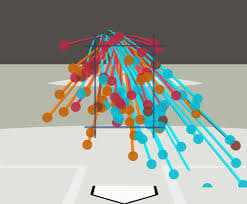
A Baseball Savant pitching chart, showing how different pitches move
Then, there’s this. I happened to read this post the other day, something I hadn’t ever read about Ted Williams before. (And I’ve read at least six books about the guy. (Just got one today - “I Remember Ted Williams.”)
A few years back, one of the Red Sox hitters in Spring Training asked Ted how to tell a curveball from a changeup.
“Oh! That’s easy,” Williams said. “If it’s a curveball, the red spot you see on the ball will be rotating clockwise — if it’s a changeup, counterclockwise.”
One of the rookies whispered to the other and says “Now who the bleep can even see a red spot on a ball coming at you at 95 MPH?”
Williams, who had 20-1o vision, went on to claim he could tell exactly where on the seams he hit the ball. They didn’t believe him.
Long-retired, Williams grabbed a bat, covered the barrel with pine tar and asked them to throw him some pitches. Ted would swing and say “across the seams” or “between the seams” or “across one seam” after each hit.
When they retrieved the baseballs, they saw Williams was right every single time. He’d tell them every time where he hit it and he didn’t miss a one. That’s how precise, that’s how exact Williams was at the plate. When he wrote a book called “The Science Of Hitting,” he wasn’t exaggerating.
Could Ted Williams utilize modern technology, video, better weight training, improved bats and apply his extraordinary technique to the modern game and still hit like nobody’s business?
Are you betting against him?
This is a wonderful article. Thank you for posting. Ted Williams has been my all-time favorite position player, even though I am a die-hard NY Mets fan. (Yes, Seaver is my favorite player.). I read My Turn At Bat 2-3 dozen times growing up. In fact, this is the only Williams book I’ve read. You and others reference many others. Where do you rank MTAB amongst these and what are your top 2-3 books that you’d recommend?
PS - it’s posts like this one that make me appreciate social media in general and Substack specifically. Thank you.
I really like your analysis. Of course Ted would utilize data to help his hitting just as defenses do to help their positioning. I think it’s likely Ted would have adjusted to higher velocity pitching as well. A couple things you did not mention that also favor Ted as potentially successful in the modern era: Batting equipment. Modern hitters are decked out like hockey goalies. Ted stood in with bare hands, short sleeves, and a cloth cap. Try controlling the inner half against Bob Feller or Bob Gibson with no protective gear. Good luck!
Another thing Ted did not have is a modern physical training and nutrition regimen. Today hitters have strength and conditioning coaches, nutritionists, massage therapists, the whole program. Can you imagine a lean and flexible Ted at 6’3” and 230lbs?