
When Babe missed the perfect exit
Ruth's three-HR game should have ended his career

EDITOR’S NOTE: This is an excerpt from my first baseball book - “Last Time Out” about the final games of the greatest players in baseball history. No player ever had a greater flair for the dramatic than Babe Ruth, yet Ruth missed what should have been the perfect exit - a three HR game against the Pittsburgh Pirates, his final HR being the first ball hit out of Forbes Field. Ninety-one years ago today, he walked off a baseball field for the final time.
May 30, 1935, Philadelphia—The final swing of the game’s greatest player did not result in a long, soaring home run. There was none of the mincing majesty of a Ruthian trot around the bases or even the extraordinary drama of a mighty whiff from the Sultan of Swat.
“No home run that Babe Ruth ever hit managed to hint at the energy, power, effort, and sincerity of purpose that went into a swing as much as one strikeout,” Paul Gallico once wrote. “Just as when he connected the result was the most perfect thing of its kind, a ball whacked so high, wide, and handsome that no stadium in the entire country could contain it, so was his strikeout the absolute acme of frustration. He would swing himself twice around until his legs were braided. Often he would twist himself clear off his feet. If he had ever connected with that one. . . .”
There was none of that here. When Babe Ruth came to bat for the 8,399th and final time of his magnificent career, he was, finally, harmless.
The Braves’ aging slugger had an aching knee, the result of an embarrassing fall on the left-field incline at Cincinnati’s Crosley Field a few days earlier. What hurt just as much, perhaps, was Ruth’s unsightly .183 batting average with just six home runs in the team’s first 27 games. It was a sad way for the game’s greatest home run king to wind up. Everyone around the game knew he was done.


Ruth’s teammate on the Braves, 19-year-old rookie Albie Fletcher, watched with sadness. “He couldn’t run, he couldn’t bend down for a ball,” Fletcher told Donald Honig in his book “Baseball America.” “And of course, he couldn’t hit the way he used to. It was sad watching those great skills fading away. To see it happening to Babe Ruth, to see Babe Ruth struggling on a ballfield, well, you realize that we’re mortal and nothing lasts forever.”
A contemporary of Ruth’s, Hall of Fame third baseman Fred Lindstrom put it even more plainly: “It was like watching a monument beginning to shake and crack,” he said. “You know, when I think back on it, it was an awful thing to see.”
So here he was, stepping into the batter’s box in the first game of a Memorial Day doubleheader at Philadelphia’s Baker Bowl, the stands barely half-full. Ruth looked out at the guy on the mound, a guy about as nondescript as it gets. He saw a 26-year-old rookie right-hander named Jim Bivin, who finished 2-9 in this, his only big-league season, allowing 220 hits in 162 innings of work.
When Ruth came up with two outs and nobody on in the first, a roar, of course, went up from the crowd. It was Babe Ruth, after all. Ruth swung mightily and topped a slow roller to first baseman Dolph Camilli. Running down to first, he felt the pain in his knee from his fall the other day. But he trotted out to left field, to try to make a go of it. The doubleheader had just started. There might be some kid who hadn’t gotten there yet. As he trotted to left, he had to be thinking about when he should have quit, when he really wanted to, about a week earlier.
He knew how he should have gone out. Nobody ever had a greater sense of the dramatic than Babe Ruth. Who hit the first All-Star Game home run? Who hit the first home run in Yankee Stadium? Who hit a home run the first time he walked up to the plate wearing his famous No. 3? What about his called shot in the 1932 World Series, whether he did it or not? Was there another player in baseball history who might even have dared do such a thing?
And, Ruth thought, he had the perfect finish. He blew it. Just five days earlier, Ruth had one of the finest games of his remarkable 22-year romp through the big leagues, swatting three home runs against the Pittsburgh Pirates. That included an extraordinary parting shot—the 714th of his career—a belt that cleared the entire stadium, the first fair ball ever hit over the right-field roof at Forbes Field.
Ruth left that game to a thunderous ovation. Why the hell didn’t he keep on walking? Former Red Sox outfielder Duffy Lewis, now the Braves’ traveling secretary, told the Babe right after that home run that he should quit and go out on top. Ruth’s wife, Claire, told him the same thing. But Braves’ president Emil Fuchs, dangling the possibility of a managerial position over Ruth’s head, lured him back.
“There are people who want to see you, Babe,” he’d tell him. He knew how badly Ruth wanted to be a big-league manager. And he knew his Braves, the worst team in baseball history, were an even worse draw without a fading Babe Ruth. Ruth had already threatened retirement two weeks before that magnificent day in Pittsburgh. On May 12, with his average at a sickly .154 with only three home runs in 21 games, Ruth told Braves’ president Emil Fuchs what he already knew—that he was washed up and wanted out right then and there.
Fuchs insisted that Ruth go on the team’s upcoming road trips to Pittsburgh, Cincinnati, and Philadelphia, all National League cities that were planning Babe Ruth Days for the former American League star.
According to Fuchs, they’d already sold a lot of tickets. Since Ruth, a career American Leaguer, had never played in National League cities Pittsburgh or Cincinnati during the regular season, reluctantly, he agreed to make the trip. But now, his knee aching, his batting average below .200, he knew it was a bad idea. Just like leaving New York.
When, in 1935, the New York Yankees dealt the aging Ruth to the worst team in baseball, the Boston Braves, just a few days after his 40th birthday, it seemed like the end was near. Ruth wanted to manage but all the Yankees would offer him was a spot managing their Newark farm club. Ruth wasn’t interested in that.
So when Fuchs hinted that Ruth might be in consideration for a managerial role—if he earned it with a season of good behavior—that was all the Babe needed to hear. Ruth opened the 1935 season with a long home run off future Hall of Famer Carl Hubbell of the New York Giants in his first National League game—incidentally, Ruth’s first at-bat against Hubbell since Ruth was part of Hubbell’s memorable All-Star Game whiff streak—Braves fans may have thought the old boy could turn back the clock.
Though Ruth had slid to a .288 average with 22 home runs and 84 RBI in his final year with the Yankees, maybe there was some kick left. The Braves—and Ruth—found out quickly that there wasn’t. He was old, out of shape, and couldn’t hit anymore. His teammates wanted no part of him. Had it been put to a vote, there’s no question that Ruth’s teammates on the Braves would have told him to leave.
He reported to Spring Training in St. Petersburg, Florida, at least 25 pounds overweight. He’d been wining and dining in Europe in the off-season. And at 40, he couldn’t move or field his position. As the season continued, two Braves’ pitchers even planned to mutiny over his poor defensive play.
But as warm weather hit the Northeast in mid-May, Ruth’s final week showed a bit of an upturn. The Babe rolled into Pittsburgh on May 23, a day that the Pirates chose to honor longtime Ruth pal Rabbit Maranville.
Ruth went hitless in three trips in a 7-1 loss, but once sent Paul Waner to the fence where he made a leaping catch of Ruth’s bid for a home run. As Waner trotted in, Ruth passed the 5-foot 8-inch “Big Poison” on the way out to his position and shook his head. “Say, you’re a mighty little fellow to be such a big thief,” Ruth told Waner.
The next afternoon, the Braves fell again, 7-6, and Ruth managed a single, his ninth hit of the season, but Waner again robbed him with a one-handed catch of a 400-foot Ruth drive.
But on that last great Saturday, Ruth had the last laugh for the last time. He homered off Pirates’ starter Red Lucas in the first, then singled off reliever Guy Bush, then homered again and in the seventh, hit one of the longest home runs of his career, a true grand finale—No. 714—that cleared the right-field pavilion.
“He still had that swing,” Bush remarked years later. “You could hear it go ‘swish.’”
Newspapers were ecstatic. “A prodigious clout that carried clean over the right-field grandstand that bounced into the street and rolled to Schenley Park,” one account said. Even the staid New York Times was gushing: “Rising to the glorious heights of his heyday, Babe Ruth, the Sultan of Swat, crashed out three home runs against the Pittsburgh Pirates Saturday afternoon but it was not enough.”
Ruth was so excited by his third home run of the afternoon, he swung by the Pittsburgh dugout after rounding the bases. “Fellas,” he told the stunned Pirate players, “that one felt good.”
It was only the second time in Babe’s career that he had homered three times in a regular-season game—he also did it twice in the World Series. The only other time Babe hit three during the season was in Philadelphia’s Shibe Park in 1930. On that day, in his fourth at-bat, Ruth waggishly took the first two strikes batting right-handed, before switching back to lefty and whiffing.
But the moment didn’t linger. The following Sunday, the Braves played in Cincinnati and Ruth showed that Saturday’s game was truly his last hurrah. He whiffed three times in a 6-3 loss on Babe Ruth Day before 24,300 fans. The next day, Ruth pinch hit in the ninth inning of a 9-5 loss and walked. On that Tuesday, he went 0-2 in a 13-4 loss but scored a run, the 2,174th of his career, just 71 fewer than Ty Cobb, then the all-time leader.
But it was in that game that Ruth also stumbled, trying to go back and field a ball on the strange Crosley Field incline in left field. He fell flat on his face and left the game in a huff. The knee continued to bother him. After an off-day, the Braves came into Philadelphia on Wednesday for Babe Ruth Day and Ruth went 0-1 in a rare 8-6 Braves’ win.
But here he was the next afternoon, out in left field, his knee sore, and his game gone. He looked up and here was a shot off the bat of Philadelphia’s Lou Chiozza in the gap. He tried to lunge after it but missed it and fell.
The ball squirted to the wall and Chiozza got to third. And suddenly, here was Ruth, walking in with a limp, calling for a replacement. The Babe never came back. With Ruth trying to mend his knee, the Braves headed back to New York for a weekend series with the Giants. And in the meantime, Ruth got an invitation to go to a grand party for the new ocean liner Normandie. He wanted to go. The Braves said no. And the fight resulted in Ruth getting his unconditional release from the Braves on Sunday night in Boston.
It was headline stuff in Monday’s New York Times. “Babe Ruth ‘Quits’ Braves and Is Dropped by Club.” “The blow-off came today when Judge Fuchs refused my request that I be allowed to go to New York Tuesday night for the Normandie celebration,” Ruth told the New York Times Sunday night in Boston. “Here’s my argument. I’ve got a bad leg, threatened with water on the knee unless I keep off it and can’t play ball. We have an exhibition game [in Haverhill, Massachusetts] scheduled for tomorrow. “I’m willing to go and hobble around in that to please the crowd. The game and my appearance have been advertised for a long time—and the Braves need the money. “But I am not fit to play in a league game. . . . So when I received this special invitation . . . I thought it would be a great honor and that it would mean a great deal to the Braves if I attended. . . . When I put it up to the Judge, he said, ‘Nothing doing!’ “Yes, I have just received my unconditional release from the Braves and I am mighty glad of it. . . . Now I’ll go to the Normandie celebration on Tuesday night, and represent baseball—but not the Braves.”
Braves’ president Fuchs sounded happy to get rid of him. “The matter came to a head today when Ruth requested permission to go to New York,” Fuchs told the Times. “[Braves manager Bill] McKechnie felt, and I agreed with him, that Ruth’s place was here, as we have games with the Dodgers on Tuesday and Wednesday.
“When permission was refused, Ruth did not take the refusal in a sportsmanlike way at all,” Fuchs concluded. “For the sake of discipline, we could not give him the extra privileges he asked for.” At the same time Fuchs was announcing he was releasing Ruth, he also took advantage of the front-page publicity to announce that the struggling team was for sale. “I am willing to sacrifice the large equity I have in the Braves if some sportsman (who will get his reward, in my opinion, both financially and otherwise), or group of sportsmen, will come along and retain the outstanding players on our club, promise me they will not sell them to other cities, and that they will protect our small stockholders.”
The newspapers were not kind to Babe, regarding the matter. Gallico, generally a Ruth supporter, mocked the Babe in a nasty farewell column that ran in the Chicago Tribune. “There are two minor notes of appealing pathos in the quitting of Babe Ruth,” he wrote. “The matter that brought this long-brewing retirement from the Boston Braves to a head was a little boy’s fit of pique and disappointment because Judge Fuchs wouldn’t let him go to what looks like a pretty swell party, the welcome to the S.S. Normandie.
“And in the Boston clubhouse, Ruth was quoted as saying, ‘The team and [Manager Bill] McKechnie are swell. They are giving me a ball autographed by all the members of the team.’ There is laughter in the first and tears in the second.” If that’s all the Braves had for one of the greatest players in the game’s history, an autographed ball, Gallico hinted, shame on them.
“They call him Babe, and Babe he is,” Gallico concluded. “Life to him is very often the life of a child and bosses are not bosses at all but grownups who interfere with his fun the way grownups always do. The greatest masters of men are those who treat them like well-loved children. Poor Babe. He wanted to go to a party where all the other kids were going.”
Even crusty old John Kieran of the New York Times took a shot at both parties. “It seems that they won’t stop swinging in baseball’s Boston team party until everyone around the place has had a chance to come to bat and hit a loud foul,” he wrote. “Let it go. Too much has been said on all sides. The Babe should have smiled and walked away. Judge Fuchs should have sent him off with a bouquet of flowers. Bill McKechnie should have gone on quietly without popping off. Each one had been doing his best with a plan that didn’t pan out. The mistake they all made was to fill the parting of ways with the sound and sight of battle.”
With Babe or not, Fuchs’s Braves finished the 1935 season with a record of 38-115, the worst record in the history of baseball until 1962’s Amazin’ Mets lost 120 games. The next night, The Babe went to the Normandie party.
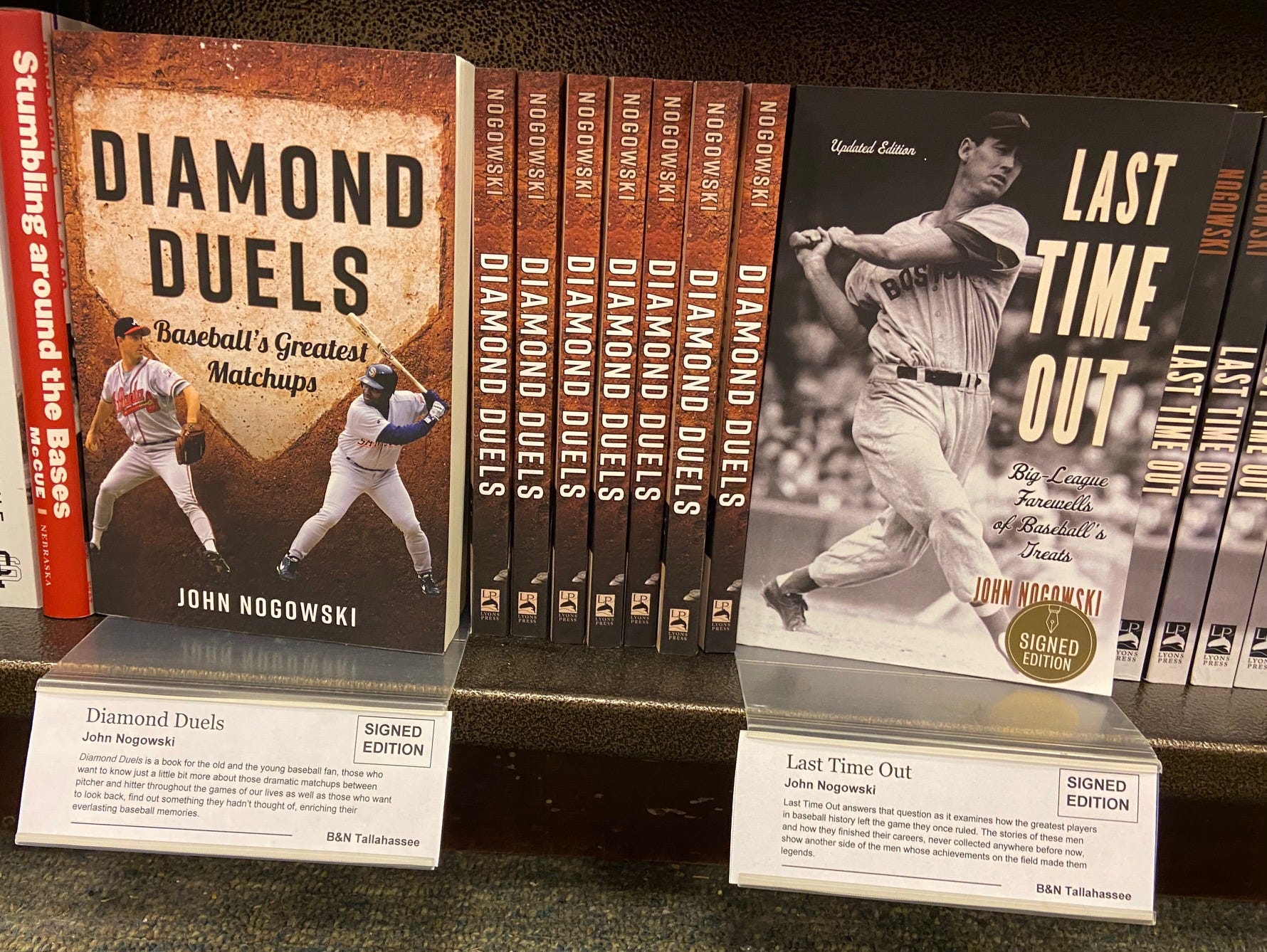
Author John Nogowski has penned two baseball books - “Last Time Out,” now in a second updated edition, and “Diamond Duels,” a deep dive into the game’s historic matchups. Both are available in Tallahassee at Barnes & Noble and Books A Million and on Amazon.
Last summer, I was a guest on Ed Randall and Kevin Kennedy’s “Remember When” show on MLB Radio to discuss “Diamond Duels.”