
When Bob Dylan said "No"
Not yet The Band, the Hawks couldn't pull it off

There was a frustration in Bob Dylan’s voice that echoed across Studio A in New York City on a Tuesday afternoon, November 30, 1965. The Hawks were trying to capture Bob’s new song, “Can You Please Crawl Out Your Window” as a single and it wasn’t going well.
“If you don’t know it, man, don’t stay in front, you’re not playing the right chords,” Dylan scolded bassist Rick Danko of The Hawks. “Does everybody know the song? ‘Cause the right chords aren’t coming across. I’ll go through it, man, if everybody doesn’t know it.”
Then moments later, “Rick, Rick, Rick, Rick. You’ve got to remember,” Dylan says. “You’ve got to really remember.”
This little tidbit, from Daryl Sanders’ insightful “That Thin, Wild Mercury Sound,” a book about Dylan’s subsequent move to Nashville to record the classic “Blonde On Blonde” is really a signpost for us. We never knew it.
Listening to the tapes of those evidently difficult recording sessions, Sanders picks up on Dylan’s frustrations to hear in the studio what he hears in his head. This is significant. Keep in mind, too, that the then 24-year-old Dylan has just two albums with a band under his belt (Bringing It All Back Home, Highway 61 Revisited), both recorded with crackerjack studio musicians and already, he’s assured that he knows what he needs to hear. Looking back, he was pretty bold and so was Columbia for listening to him. Dylan’s musical sophistication was on speed dial. He knew exactly what he wanted and what he was hearing, ain’t it, babe.

Dylan’s third try for a hit single after “Like A Rolling Stone” and “Positively Fourth Street.”
After the debacle at Newport, depicted so well in the recent film “A Complete Unknown,” Dylan had hired the Hawks as his backup band in September. They had played a handful of shows together in the fall and when Bob optimistically brought them into a recording studio in October, he was disappointed that what he heard, just didn’t work. Where he was, musically, wasn’t quite where they were, then.
As Dylan told Robert Shelton a bit later, “Oh, I was really down. I mean, in like ten recording sessions, man, we didn’t get one song. It was the band. But you see, I didn’t know that. I didn’t want to think that.”
In hindsight, we can see now why Bob opted to take the advice of producer Bob Johnston and take his stuff to Tennessee’s musical capital in what then, what seemed a really radical move. Why Nashville? Now, we get it.
Since he and The Hawks, soon to become The Band, had already done a handful of shows together in the fall, warming up before they embarked on that wild and wooly world tour together where they were booed almost every night, there seemed to be such a remarkable connection between the two.
Bob would turn to them to do The Basement Tapes in the summer he recuperated from a motorcycle accident (and the effects of the tour), he’d roll out of seclusion, turning down Woodstock to play with them at the Isle Of Wight and a Woody Guthrie tribute. Later, they would record “Planet Waves” and tour the USA together in 1974. Bob would wrap up their farewell, “The Last Waltz” with them in San Francisco’s Winterland, there was such a link, it was destiny, it seemed.
Not knowing about those musical struggles in the fall of 1965, it was surprising to me that, at that time, evidently, Bob and what would become The Band, weren’t musically simpatico. Bob needed something else. Funny how things would change thanks to that baptism of fire that was the 1966 world tour.
Once I started into the Dylan world, I had always wondered why, if he did “Crawl” with them in New York in November, he didn’t do “Blonde On Blonde” with the Band, too? Robbie had played on “Obviously Five Believers.” Why Nashville for a rock album? It’s only now that you can put the pieces together and write the narrative.
One of his strangest lyrics, “Can You Please Crawl Out Your Window” was too obtuse for hit radio, something, famously, Phil Ochs tried to tell Bob at the time. (Or so the story goes.) Bob forged ahead anyway.
Bob had tried to record “Crawl” earlier, in July in Studio A with a different band including Paul Griffin and Mike Bloomfield but it wasn’t what he heard in his head. He let it go.
When Bob brought The Hawks into the studio with him in October, he tried cutting it again. But that didn’t go well, either. He finally gave the song one last shot in November, just five days after Thanksgiving.
At the time, The Byrds’ chiming take on Pete Seeger’s “Turn, Turn, Turn” was No. 1 on the charts so it seemed “folk rock” was having its day. Since Bob had scored well on the charts with “Like A Rolling Stone,” which went to No. 2 and he followed up that chart success with “Positively Fourth Street,” which rose to No. 7, the idea was “Can You Please Crawl Out Your Window,” would be next. Nope.
Released four days before Christmas, even Santa didn’t like it and the single went nowhere, No. 58. Other than a quick blip with “Rainy Day Women #12 and #35,” off “Blonde On Blonde” Dylan wouldn’t be back on the charts for a while.
To me, “Crawl” always sounded like a wild orphan. I first heard it on “Biograph” and never understood it as the reason Bob made the Nashville move, which, let’s face it, back in the day, was shocking.
The idea of a wild-haired, dope-smokin’, fast-talkin’, lyric-writin’ smart ass heading into the middle of Nashville’s country music factory made no sense, except, perhaps to Johnston, who could sense (and hear) Dylan’s growing frustration with what he heard in studio session after studio session.
Johnston rightly figured the subtly textured musical accompaniment that matched what he heard in his head — correctly, it turned out — could be supplied by Nashville’s master musicians and he couldn’t have been more right. Lucky for us. “Blonde On Blonde” is the evidence.
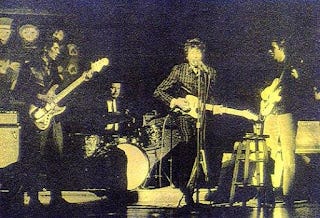
Bob Dylan and The Hawks playing in Hartford in October of 1965
Here’s Take 1 of “Can You Please Crawl Out Your Window”
The third edition of John Nogowski’s book, “Bob Dylan: A Descriptive, Critical Discography 1961-2022” is available on Amazon and locally, at Barnes & Noble in Tallahassee.

I seem to recall hearing Mark Lewisohn say, that during his Beatles research he came to the conclusion that there were so many “coincidences” in their career that perhaps there was some bigger destiny at work, something we can’t yet understand. I’ve also felt that way about Dylan. Nashville could’ve also been a huge flop, but it wasn’t and the result was truly magical.
Dylan is one of a kind.