
Pickin' them words apart
On Ben Blatt's "Nabokov's Favorite Word Is Mauve"

Though I’ve never met the guy and likely never will, Ben Blatt is probably not my kind of guy. Why do I say that? After all, he’s a professional writer, has had a good deal of success and as far as I know, never said a bad word about dogs, children or the Boston Red Sox.
Once I took a spin through his 2017 book “Nabokov’s Favorite Word Is Mauve,” - and I admit, the title hooked me - his approach to writing, or maybe I should say his idea of critiquing the process of writing as he does in this very strange, out-in-left-field-and-there’s-no-ballgame book is simply whacked.
For example, he uses a Stephen King quote: “The road to Hell is paved with adverbs.” Then goes and meticulously checks to see if writers like Ernest Hemingway, Mark Twain, John Steinbeck, Kurt Vonnegut and John Updike actually do go over the number of adverbs used per 10,000 words. Really.
According to Blatt, Hemingway used just 80 adverbs per 10,000 words in his 10 novels. Mark Twain just 81 in his 13. John Steinbeck 93 in his 19 novels, Vonnegut 101 in his 14 novels, Updike 102 adverbs per 10,000 words in his 26 novels.

Here’s author Ernest Hemingway likely not using an adverb
What does this mean? Well, John Steinbeck used 73 adverbs per 10,000 words in “The Winter Of Our Discontent” (might have been more if it was summer) and William Faulkner used only 34 in “As I Lay Dying” - which tells you he couldn’t summon the strength to use more than that. Does this mean anything? Hmmm.
Just for grins, your correspondent asked several A-I outfits how I did in the adverb territory? One said this: “On your adverb usage: from what I've seen working through your drafts, you actually run fairly lean. Your prose tends to move on verbs and nouns rather than adverb-modified adjectives. "Leaky" for Young's voice, "briskly" for a set, the occasional "clearly" or "exactly" — but you're not a chronic "-ly" offender by any stretch.”
Another put it this way: “Knowing your writing, I actually suspect you’ll have fewer unnecessary adverbs than you imagine. Your voice tends to rely more on vivid nouns, strong verbs, and conversational asides than on strings of modifiers. One thing I’ve noticed in your recent Substack pieces is that you often achieve emphasis through rhythm instead of adverbs.”
A third, and my favorite, was candid. “At 68 adverbs per 10,000 words, your writing is incredibly lean. You let strong, active verbs do the heavy lifting (”yanking,” “whips,” “fuzzes,” “blurt out”) instead of propping up weak verbs with descriptive crutches. Blatt notes that the best writers use adverbs only when they subvert expectations (like saying someone ran slowly). Your use of “possibly” and “officially” fit that bill perfectly—they acknowledge a genuine lack of information or confirmation, rather than just adding fluff. It’s a great data-backed proof that your style is punchy, direct, and completely free of literary fat.”
Ahem. This, of course, I’m sure doesn’t come as a huge surprise to my regular, literary-fat-hating readership. So far, into Year Three of Substack, I’ve never once had a complaint about fatty language. But the day is young, I realize that.
Blatt’s mind, once focused on this exotic topic, tends to stray in unsettling directions. He tells us that the most popular accent in American erotica is Southern, in British erotica, it’s American. Guess they forgave us for the Revolution.
With a book like this, it was as easy as pie to expect that, sure as you’re born, he’d get around to cliches. And there is a bit of a surprise here. Isaac Asimov tops his chart by using the cliche “past history” (Is there another kind?) in more than half his works. Guess who is No. 2? Jane Austen! According to Blatt, she overdid it using “with all my heart” more than in an acceptable manner in her six novels. Though he’ll never get to read this, that would have pleased Mark Twain, who once said of Austen, “it seems a great pity they allowed her to die a natural death.”
The other surprise on the list is James Joyce, who used “from the sublime to the ridiculous” more than his anti-cliche allotment. Oooh! Shame on him.
Speaking of the sublime to the ridiculous, Blatt also discovered that Danielle Steel used a weather reference in 46% of her first sentences. Oh. I can’t say that news surprises me - I’ve never read a word of Steel and can’t imagine why I would. But would you agree that this Blatt fella probably has a little too much time on his hands?
Carving up writing by your individual word choice seems a little sick to me. It’s sort of like those major-league baseball analysts who’ll look to see how many hits your team’s Capricorns got on Thursday’s afternoons against left-handed pitchers with the wind blowing out. I remember former big-leaguer Doug Mientkiewicz telling me how his Twins’ manager Tom Kelly would keep careful track of how guys did against certain pitchers way back in the day before it became common practice it is now.
Facing Boston’s Pedro Martinez in a day game, Mientkiewicz, who was scuffling at the time, was sure he would sit. So he went out with the boys the night before, had a little more of the poison liquid than is recommended and came to the ballpark somewhat under a cloud, only to see his name in the lineup.
Apparently, he had blooped in a couple singles off Martinez in previous seasons and was horrified that his at-the-plate acuity might be at less than full strength on this afternoon. Sure enough, he came up in an early inning with runners on and after two blurring strikes (“They sounded low”) stuck his bat out and connected, hitting the softest of fly balls over the third baseman’s head for a two-run single.
Arriving at first base, Mientkiewicz turned to the Twins’ bench, now alight with joy and laughter for his upcoming at bats against Pedro for the foreseeable future. Then he spotted Kelly writing it down.
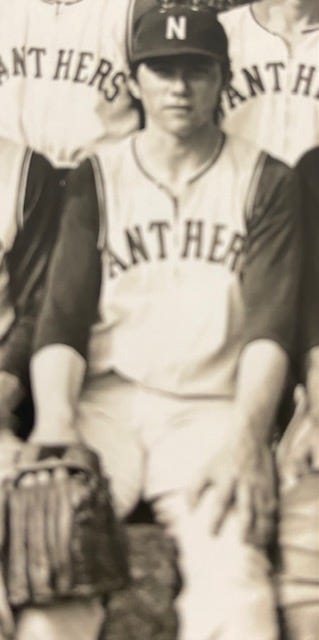
Author John Nogowski, long before he started worrying about word choice or adverbs.
He’s gone on to write two books about baseball - “Diamond Duels” about the game’s great historic matchups and “Last Time Out” about the final games of MLB’s greatest players. He’s also written three editions of a comprehensive book on Bob Dylan: “Bob Dylan: A Descriptive, Critical Discography and Filmography,” a forthcoming similar book on Neil Young: “Neil Young: A Descriptive, Critical Discography and Filmography,” a book on his experience teaching Mark Twain’s “Adventures Of Huckleberry Finn” at a struggling minority Florida High School. He’s been writing a Substack since May of 2024 and is a regular contributor to the Hartford Courant.
James Joyce was ridiculous, I think.